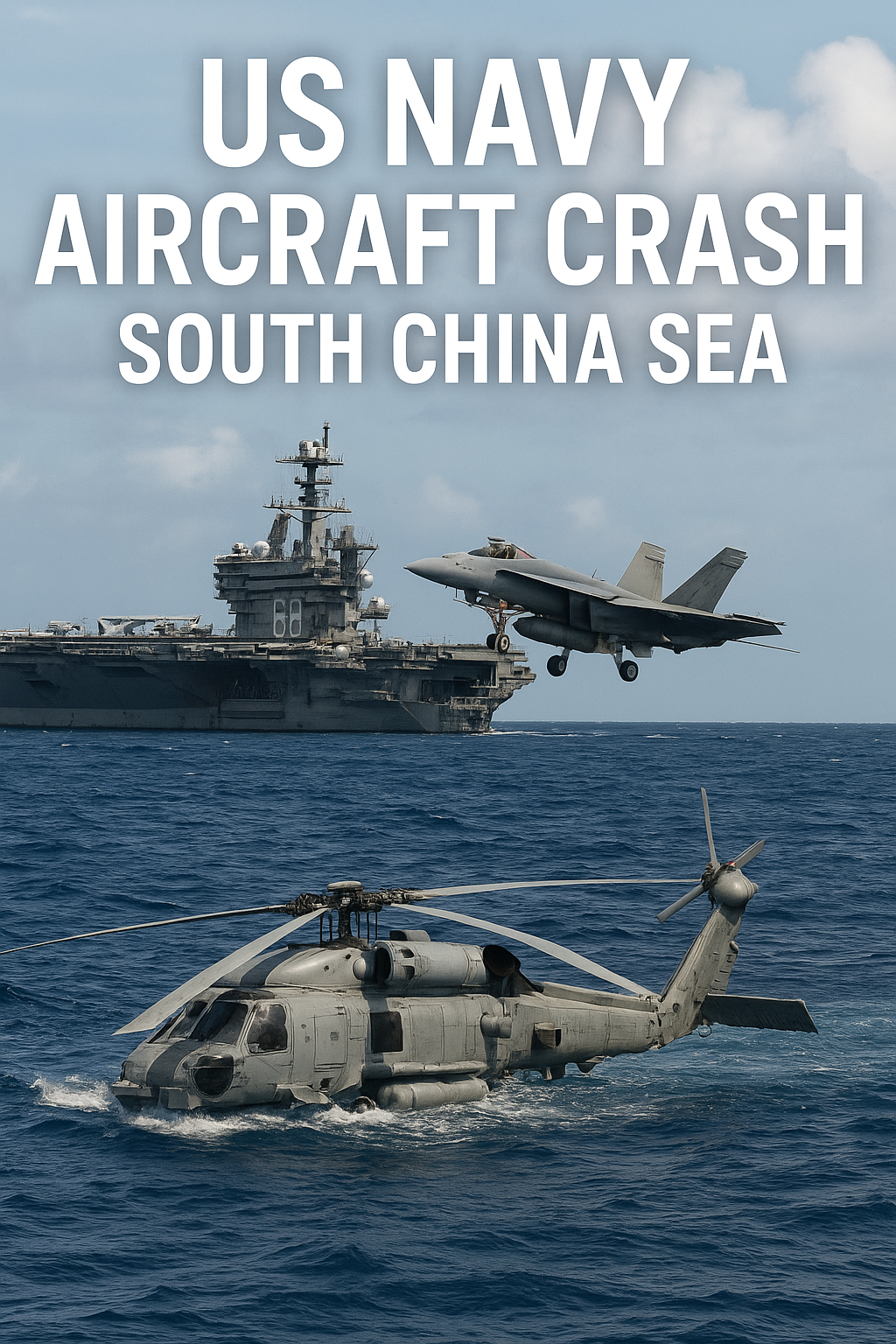
Thirty minutes apart, two crises occur: a US Navy aircraft crash into the South China Sea
On October 26, 2025, two US Navy aircraft crash into the South China Sea within about 30 minutes of one another, in a very unusual turn of events. According to the U.S. Pacific Fleet, both incidents happened while the aircraft were performing “routine operations” on the same aircraft carrier, the USS Nimitz (CVN-68).
The events leading up to the US Navy aircraft crash
First, an MH-60R Sea Hawk helicopter from Helicopter Maritime Strike Squadron 73, “Battle Cats,” which was flying out of the USS Nimitz, went down in the South China Sea at approximately 2:45 p.m. local time.
An F/A-18F Super Hornet fighter jet, belonging to Strike Fighter Squadron 22, also known as the “Fighting Redcocks,” was launched from the same carrier and crashed into the waters approximately thirty minutes later at 3:15 p.m.
All five of the participating service members were safely rescued and are in stable condition in both cases. The two crew members of the jet successfully ejected before the crash, and the three crew members of the helicopter were hauled out of the water.
The causes of both are being investigated by the US Navy Aircraft Crash.


Why the US Navy Aircraft Crash Is Important
Sensitivity to geopolitics:
- One of the world’s most disputed maritime areas is the South China Sea. China’s broad territorial claims are contested by a number of regional nations, including Vietnam, the Philippines, Taiwan, Malaysia, Brunei, and Indonesia. In part to offset China’s military buildup, the U.S. Navy regularly carries out carrier and freedom-of-navigation operations there.
Timing strategy:
- The incident happened during Donald Trump’s diplomatic tour in Asia, which included meetings with Chinese officials. The two crashes raise concerns about operational risk as well as potential ramifications for relations between the United States and China.
Hazard to equipment and human life after US Navy Aircraft Crash :
- Although there were no fatalities, it is uncommon to lose two valuable assets in quick succession. Both the F/A-18F and the MH-60R are important platforms that are costly to operate and maintain.
What We Know and What We Don’t Know About US Navy Aircraft Crash
Recognised facts:
- In the South China Sea, both planes were flying out of the USS Nimitz.
- Both crews were successfully and steadily rescued.
- There is currently no official cause, but investigations are underway.
- According to China’s Foreign Ministry, Beijing would offer humanitarian aid if the United States requested it.
Unknown or being looked into:
- the precise locations of the collisions. No specific location information has been made public by the Navy.
- if there is a connection between the two crashes—a mechanical problem, contaminated fuel, human error, or outside interference. Because of the short notice, there is some conjecture.
- Both aircraft’s complete mission information at the time of the incident—training, patrol, and carrier launch/landing cycle—has not been made public.


Theories and Potential Reasons for the US Navy Aircraft Crash
Problems with fuel or upkeep:
- The Independent claims that during press appearances, President Trump alluded to a potential “bad fuel” problem.
Platform for ageing and operational tempo:
- This deployment is reportedly the last one before the USS Nimitz, the oldest carrier in the U.S. fleet, is retired. It was put into service in 1975.
Environmental aspects:
- Risk may be increased by the South China Sea region’s difficult sea conditions, unpredictable weather, and heavy traffic.
Risk to geopolitics:
- Even though there isn’t any proof yet, the fact that this happened in disputed waters raises the possibility that direct or indirect outside interference contributed to the incident or at the very least raised concerns. China’s statement that US operations are “undermining regional peace and stability” is pertinent.
Background Information on the US Navy Aircraft Crash
- For both military operations and maritime trade, the South China Sea continues to be a vital route. In order to guarantee freedom of navigation and reassure its allies in the region, the United States keeps carrier strike groups there.
- The MH-60R Sea Hawk helicopter is an advanced maritime tool utilised for surface combat, search and rescue, and anti-submarine warfare missions. According to Business Insider, it depends on intricate logistics and costs tens of millions of dollars.
- The F/A-18F Super Hornet is a contemporary multirole combat jet that is frequently used by the U.S. Navy; in the past 12 months, U.S. Navy forces have lost four of these aircraft.
- The U.S. Navy has experienced a series of mishaps in recent months, including jets going overboard and incidents in the Red Sea. Concerns regarding fleet maintenance, readiness, and training procedures have grown as a result of the Nimitz crashes.


Potential Consequences of the US Navy Aircraft Crash
Pause in operations and more inspections:
- Until the underlying causes are identified, the Navy may suspend similar routine operations or increase inspection cycles throughout the fleet, especially for carrier-launched aviation.
Public and Congressional scrutiny:
- Even though there haven’t been any fatalities yet, the incident might still lead to congressional hearings regarding the safety, preparedness, and cost of carrier aviation.
Regional signalling:
- Beijing views China’s open offer of humanitarian aid as a component of a larger messaging strategy that aims to portray Beijing as a cooperative regional actor and to emphasise how provocative U.S. operations are.
Pressure on maintenance and the budget:
- Cost burdens are increased by aircraft losses; each Super Hornet and Sea Hawk is worth tens of millions of dollars. It’s likely that enquiries will be made regarding logistic support, usage volume, and ageing platforms.
Risk of escalation:
- Even though this seems unintentional, any mishap in disputed waters carries the risk of misunderstanding, escalation, or political friction, particularly in light of the current tensions between the United States and China.
What to Watch: A US Navy aircraft crash
- The U.S. Navy’s official investigation report from the U.S. Pacific Fleet probably identifies the root cause or causes and suggests solutions.
- updates on the mission profile and whether the crash happened during a training or special operation flight.
- Chinese reaction or analysis that goes beyond humanitarian aid, such as allegations of meddling or Beijing’s involvement.
- impact on whether other carriers change their operations in the area and the remaining deployment of the USS Nimitz.
- The implications of this for U.S. carrier aviation safety standards and posture in the Indo-Pacific are discussed by the media and defence analysts.