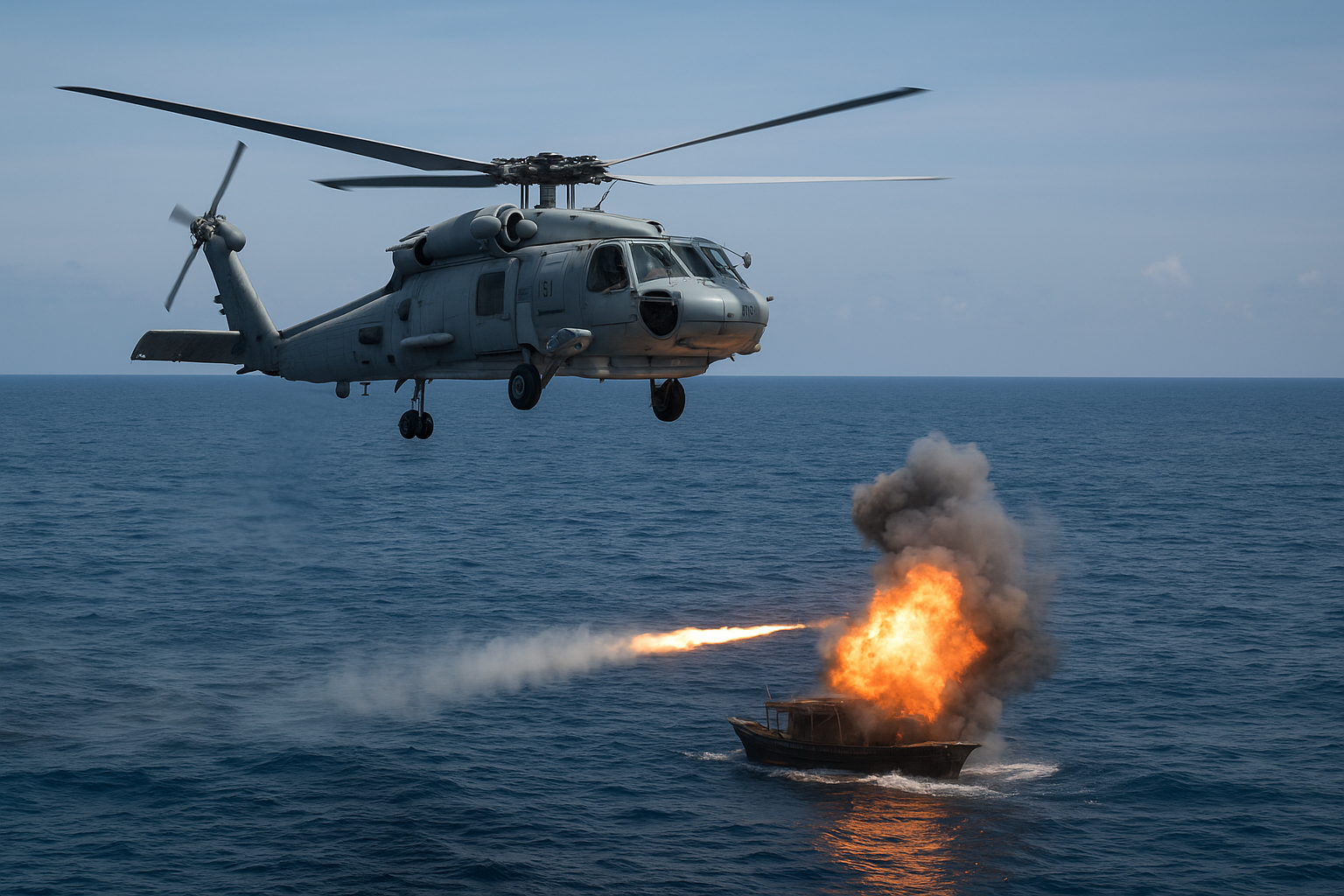
A deadly US military strike sinks a suspected drug-smuggling vessel in the Caribbean.
An abrupt increase at sea
An alleged drug-smuggling vessel traveling along a known narcotics route in the Caribbean Sea was the target of what the U.S. Department of Defense (DoD) confirmed was a “lethal kinetic strike” by US military forces on the evening of November 2, 2025.
US military officials said the ship was “known by our intelligence to be involved in illicit narcotics smuggling” and was controlled by a U.S.-designated terrorist organization.
One of the deadliest single incidents in the recent spate of maritime operations targeting drug-trafficking vessels, the strike reportedly claimed the lives of at least seven people on board the ship. (Some outlets report three killed; US military officials suggest the tally is higher.)


The larger campaign US military
Since September 2, 2025, the United States has launched a broad campaign against small boats and semi-submersibles in the eastern Pacific and Caribbean Sea that are suspected of transporting significant amounts of drugs.
Thus far:
- There have been at least 14 ships hit or destroyed.
- These strikes have claimed the lives of at least 60 people.
- The campaign has been classified by the United States as a “non-international armed conflict” with “narco-terrorist” organizations.
- The area has seen the mobilization of a sizable naval force, which includes aircraft carriers and stealth jets.
What the US military claims is at risk
US military officials claim that:
- These ships are carrying heavy loads of drugs in the direction of the US mainland while operating along well-known drug-trafficking routes.
- Because these boats are home to designated “terrorist” organizations, traditional law enforcement measures are considered inadequate, which leads to the use of military force.
- According to the DoD, the strike did not injure any American personnel.


Legal and regional repercussions for US military
The campaign has drawn harsh criticism, despite the United States portraying it as a daring crackdown on drug supply chains:
- Since the strikes use lethal force in international waters outside of a declared war zone, the United Nations Office of the High Commissioner for Human Rights (OHCHR) and other rights organizations claim that they may be extrajudicial killings and violate international law.
- The White House has not publicly disclosed the target lists, complete legal justifications, or confirmation that drugs were present on the attacked craft, according to critics, who claim that this lacks transparency.
- Latin American governments have voiced their concerns. For example, Venezuela’s government has condemned the operations as aggressive and a violation of its sovereignty.
- Concerns about constitutional war powers are being used by some lawmakers in Washington to demand oversight.


Why this is important
Worldwide narco-networks
- Given the size and regularity of the operations, it appears that the maritime drug pipeline, which runs from South America through the Caribbean and Pacific, is a top national security concern for the United States. A change in approach is indicated by the use of military force as opposed to conventional interdiction.
A note to traffickers
- The United States seems to be trying to dissuade cartel groups by showing that distant maritime operations are no longer safe from military attack by making statements and video publicly available.
Conflict with international law
- The operations cast doubt on the circumstances under which a country may employ deadly force against non-state actors in international waters. There is still debate over the legal threshold for “armed conflict” and the function of congressional authorization.
The stakes for regional diplomacy
- These actions may be seen by many Latin American and Caribbean states as unilateral militarisation of the region. Cooperation against drug-trafficking networks, which frequently relies on pooled intelligence and coordinated law enforcement efforts, may be strained as a result.


Next things to watch
- Will the United States provide more specific evidence to support its claims, such as the types of drugs recovered, vessel ownership, and actor designations?
- How will regional and allied governments react? Will they try to restrict US military action in their maritime zones, demand joint oversight, or push back diplomatically?
- Will the legal foundation for such offshore military operations against non-state actors be clarified or limited by Congress?
- Could drug-trafficking organisations take retaliatory or escalated actions in response to this campaign (e.g., arming their vessels or attacking patrol craft)?
- As political and legal pressure mounts, will the campaign’s approach change (for instance, moving from strikes to boarding and seizure operations)?