Trump Delivered the Hard Truth to the U.N.: It Was a Failure
Donald Trump’s September 2025 speech to the UN General Assembly was more than just a speech; it was a daring critique of the organisation. He accused the U.N. of failing in its fundamental mission in plain, direct terms. In an era of escalating geopolitical tensions, Trump’s message, “Trump Told the U.N. the Hard Truth: It Failed,” struck a chord with audiences worldwide, igniting discussion, opposition, and a reexamination of multilateral institutions.
We examine his arguments, their foundation, the rebuttals, and the implications for future international collaboration in this post.
Setting the Scene: An Important Speech of Trump
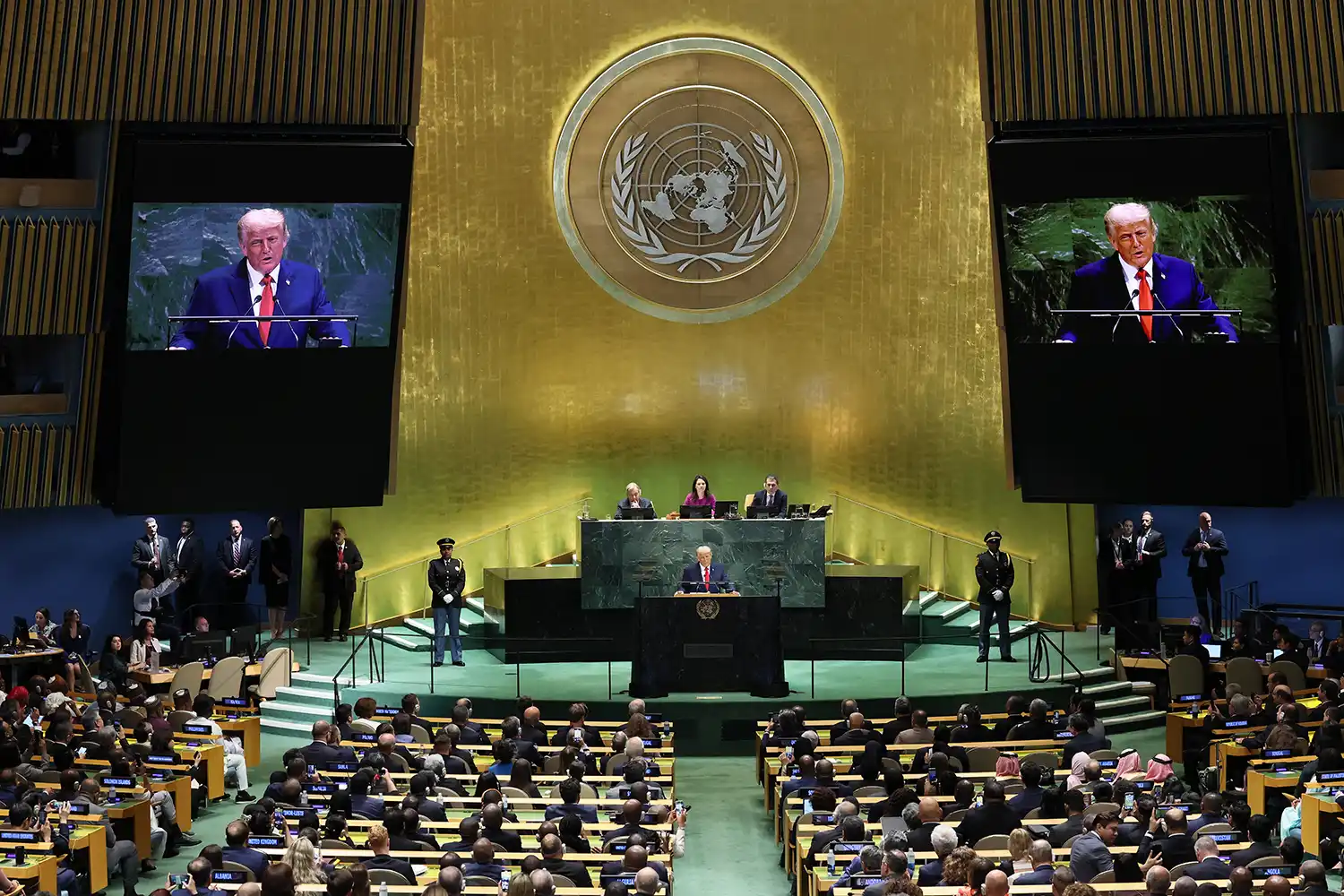
President Trump spoke for almost an hour at the U.N. General Assembly on September 23, 2025.
- Rhetorical flourishes, self-congratulation, and scathing criticism characterised the speech.
- Trump aimed to shift the focus from international issues to the U.N.’s own performance from the beginning. He specifically stated that the UN was “not even coming close to living up to that potential” and that it far too frequently relied on “strongly worded letters” instead of taking decisive action.
- In order to emphasise his main point—that the organisation is experiencing dysfunction, even on a minor level—he also interwoven symbolic jabs, such as lamenting a broken escalator and a broken teleprompter at U.N. headquarters.
But in order to properly understand the significance of “Trump Told the U.N. the Hard Truth: It Failed,” we need to look at the core of his accusations rather than just the showmanship.


The Main Point: Trump’s Argument That the U.N. Failed
1. A Time-Frozen Security Council
- The notion that the United Nations Security Council (UNSC), which is tasked with resolving disputes and maintaining peace, is structurally out of date is at the heart of Trump’s criticism. According to ForeignPolicy, the Security Council’s architecture has largely stayed the same despite changes in the balance of power in the world. The Security Council was created in the aftermath of World War II, with the winners serving as permanent members.
- Trump claimed that the U.N. has been unable to take decisive action in many conflicts because of entrenched veto power and the geopolitical gridlock it allows.
- He pointed to historical events such as the Korean War (1950) and the Gulf War (1990) as examples of infrequent times when the United Nations truly operated, implying that outside of those times, it has mostly failed.
2. Too Much Talk, Not Enough Doing
- “The U.N. is mired in empty words” was one of Trump’s recurrent themes throughout his speech. He chastised the group for making declarations, resolutions, and statements but failing to act on them. He claimed that after writing a letter with strong language, they never follow up.
- Trump argued that action is necessary to end wars, not just rhetoric. He therefore portrayed the U.N.’s approach as inadequate for dealing with actual crises.
3. Climate Change, Migration, and “Green Scam”: An Analysis of U.N. Priorities
- Trump focused a large portion of his speech on two interconnected topics: green energy/climate policy and migration. He cautioned European leaders that a focus on renewable energy and open borders would cause a country to decline: “Your country will fail if you don’t escape this green scam.”
- Additionally, he denounced the “failed experiment” of open borders, saying:
“Your nations will burn in hell.”
- He believed that the United Nations’ agenda, which placed a strong emphasis on global governance, refugee resettlement, and climate mitigation, was undermining prosperity and sovereignty.
4. Trump’s Personal Role: Asserting His Position as a Peacemaker
- Trump simultaneously criticised the U.N. for its inaction and claimed that his administration had completed the necessary work. His repeated claims that he had “ended seven wars” were deemed misleading or overstated by fact-checkers.
- “It’s too bad that I had to do these things instead of the United Nations doing them,” he continued on several occasions.
- As a result, his criticism of the UN wasn’t objective; rather, it was connected to supporting his own claims of efficacy and leadership.


Reactions & Opposition: Is the UN Truly That Broken?
Despite his forceful delivery, Trump’s claims have come under intense scrutiny. Key rebuttals and factual checks are provided below.
Errors in Fact-Checking and False Statements
Several false or deceptive statements were found in Trump’s speech by media outlets and fact-checkers:
- His depiction of immigration and deportation statistics was contested. His commendation of El Salvador for locking up criminals deported from the United States, for example, obscured the fact that many of them had no criminal histories.
- There was no solid evidence to back up his claim that the United Nations pays for migrants to enter the country.
- Many people questioned the idea that “seven wars ended.”
According to The Guardian’s fact-check, Trump’s frequent criticism of the U.N. included a number of untrue and deceptive statements, especially regarding immigration, climate change, and U.N. funding.
Analysts and the U.N.: Not Everything Is Failure
Trump’s portrayal has drawn criticism for being overly simplistic and for ignoring international cooperation’s complexities, limitations, and reforms.
- The Council on Foreign Relations cautioned that disparaging the United Nations could jeopardise international cooperation just when it’s most needed.
- The U.N. provides crucial platforms for diplomacy, humanitarian coordination, peacekeeping, and normative governance, despite its slowness and bureaucracy, according to some academics and diplomats.
- Adjusting representation, rethinking veto power, boosting accountability, and strengthening regional voices are among the reforms that have been suggested for decades. Although progress is slow, the U.N. is rarely static in practice.
Substance versus Symbolism
The media criticised Trump’s allusions to malfunctioning teleprompters and escalators:
- The U.N. retorted that the defective teleprompter was under American control and that the escalator safety stop was probably caused by White House media operations.
- These allusions offered little in the way of constructive vision or policy critique, despite their symbolic flair. They served as rhetorical devices to punctuate his larger indictment, according to some analysts.
Breaking Down the Message: What’s Actually at Risk?
Upon dissecting “Trump Told the U.N. the Hard Truth: It Failed,” a number of more significant themes show up.
Opposition to Multilateralism
- Trump’s message subtly rejects the multilateral framework that supports the United Nations. He prefers national self-reliance over collective frameworks, bilateral agreements, and sovereignty-first strategies.
- This reflects scepticism about institutions that can limit state autonomy and aligns with his America First doctrine.

Messaging and Political Branding
Trump’s speech at the U.N. has both a domestic and a diplomatic purpose. He reinforces a narrative of executive strength and decisive leadership, attributes he hopes voters will value, by portraying himself as the actor who had to make up for the U.N.’s shortcomings.
The Conflict Between Abolition and Reform
Trump steers the discussion towards a central query by calling the U.N. a failure: should it be scrapped or salvaged? The following options are available if the U.N. is seriously flawed:
- Significant structural changes (accountability, funding, Security Council)
- Adding new organisations to the U.N. or replacing it
- slipping into a world of national first policies and ad hoc coalitions
Since many states profit from the status quo and effective reform is politically challenging, incremental change is preferable.
What Might Happen Next?
Several paths are conceivable given how effective Trump’s message is:
U.N. legitimacy erosion in some blocs
- His criticism could be used by some countries or groups as an excuse to further deviate from U.N. standards or to weaken the organization’s authority.
Encourage internal reform
- Delegates with a reform mindset might rewrite stories by adopting modernisation, accountability, transparency, or changing the rules governing decision-making.
A rise in polarisation
- Multilateralist nations may retaliate by further reducing U.N. funding or arguing diplomatically with the United States.
Architectures that are hybrid
- When the U.N. is unable to take action, new organisations or coalitions (such as issue-specific coalitions or regional security pacts) may become popular as backup or parallel mechanisms.
In conclusion, was Trump correct?
We must distinguish between institutional criticism and rhetorical flourish when considering “Trump Told the U.N. the Hard Truth: It Failed.“
His diagnosis that the United Nations, particularly its Security Council, frequently fails to resolve significant conflicts is accurate.
To support his claims, he frequently embellishes or misrepresents facts.
His criticism does not address the intricacy of global governance or provide a clear way forward.
Ultimately, his speech questions the smug acceptance of multilateral institutions and asks whether the United Nations can be saved, and if so, how, or if it should be replaced by new architectures more appropriate for the twenty-first century.