Trump Hits China With 100% Tariffs—An Unexpected Increase
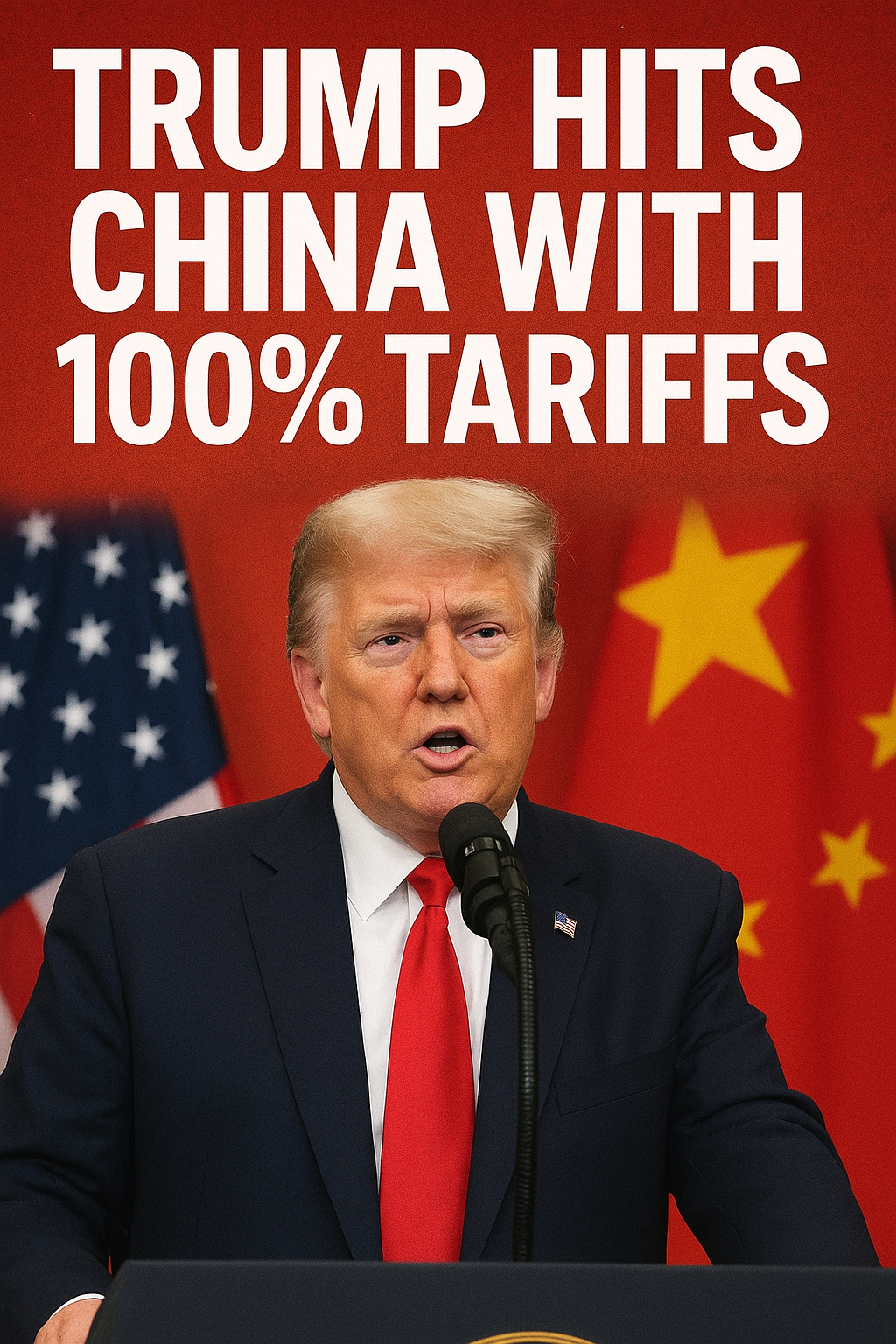
U.S. President Donald Trump has declared that the United States will impose China With 100% Tariffs on Chinese imports beginning November 1, 2025, a dramatic move that threatens to undo recent diplomatic détente. The current tariffs would be supplemented by this new levy.
Trump’s declaration was specifically linked to Beijing’s recent action to increase export restrictions on rare earth minerals, which are essential components for the defence and high-tech sectors. He announced that the U.S. would go beyond simple trade tariffs by enforcing export controls on “critical software.”
Trump said in his announcement that “now there seems to be no reason” to meet with Chinese President Xi Jinping, raising doubts about whether the scheduled meeting should proceed. Later on, he clarified that although he had not officially cancelled it, the future was extremely uncertain.
This action raises doubts about the likelihood of the Trump-Xi meeting and represents a dramatic increase in trade tensions between the United States and China.
Export restrictions, rare earths, and Spark Trump Hits China With 100% Tariffs


China’s recent export restrictions on rare earth minerals provide an explanation for Trump’s aggressive actions. Manufacturing in industries like electric vehicles, defence systems, semiconductors, and green technologies depends on these elements (such as neodymium, dysprosium, and others). China already has considerable clout because it processes the majority of the world’s rare earth production.
Under Beijing’s new regulations, any product that contains rare earths from China would need special approvals, even if it is put together somewhere else. Trump threatened to impose tariffs because Washington saw these export restrictions as an aggressive action.
As a result, the United States is defending the tariff increase by claiming that China is weaponising vital resources.
China’s Response: Tactical Restraint, Accusations, and Defiance Trump Hits China With 100% Tariffs
Beijing has responded firmly at first. China has urged the United States to settle disagreements through “dialogue, not threats,” vowing not to back down. The Commerce Ministry condemned Trump’s combative strategy as hypocritical and charged Washington with enforcing “double standards.”
Despite its strong criticism of the tariff move, China has not yet publicly imposed broad new retaliatory tariffs on U.S. goods. This is perceived by observers as deliberate restraint, perhaps intended to limit escalation or maintain space for negotiation.
However, China had previously imposed or threatened countermeasures like export restrictions and port fees on American ships. Qualcomm was also the subject of an antitrust investigation by China.
Trump Hits China with 100% teriffs at the Xi Jinping Meeting: Doubt, But Not Dead


The scheduled meeting between Trump and Xi is among the most direct diplomatic casualties of this escalation. The Asia-Pacific Economic Cooperation (APEC) meeting in South Korea was anticipated to coincide with the summit.
Trump said in his announcement that “there seems to be no reason to do so,” raising doubts about the wisdom of holding the meeting in the current environment. That is interpreted by some analysts as a sign that the meeting may be called off.
Trump later clarified that he had not formally cancelled, leaving the door open to be determined by China’s next actions. Therefore, depending on how both parties manoeuvre in the upcoming weeks, the meeting is still in limbo.
Should it be cancelled, diplomatic channels would suffer a serious setback, possibly forcing efforts into secret talks or increasing the likelihood of more retaliation. It would probably occur in a more hostile environment and under far harsher circumstances if permitted to proceed.
Effects on the World and Markets: Trump Hits China With 100% Tariffs

Global markets have been rocked by this abrupt switch to China With 100% Tariffs.
- According to reports, the S&P 500 fell 2.7% in the United States, the most since April.
- The announcement of the tariff was partially responsible for the $18 billion drop in the cryptocurrency market.
- Tech stocks have been especially vulnerable, particularly those that depend on rare earth components or Chinese supply chains.
- Trade-dependent industries are experiencing a decline in confidence. Businesses that rely on Chinese components or materials may experience supply shortages or unexpected price increases.
Beyond markets, this increase may have an impact on global supply chains, especially in the automotive, electronics, renewable energy, and defence industries. There may be repercussions for nations that serve as middlemen or depend on Chinese components.
The escalation, in geopolitical terms, reinforces dividing lines: nations may face pressure to “choose sides” or shift supply chains away from the United States or China.
Trump Hits China With 100% Tariffs in Risks, Motivations, and Strategic Calculus
Why has Trump gone this far?
- Leverage and signalling: The United States is demonstrating its willingness to escalate further if pressured by imposing China With 100% Tariffs.
- Reacting to China’s rare earth move: Trump may view tariffs as a counterbalance because he views China’s control over rare earth supplies as a strategic vulnerability.
- Domestic politics: Trump’s base and campaign messaging benefit from his tough stance on China.
- Negotiation stance: Trump might be hoping to gain concessions at the negotiating table by intensifying.
However, there are serious risks: Trump Hits China With 100% Tariffs
- Retaliation and backlash: China may eventually use export restrictions, sanctions, or regulatory pressure on American companies doing business in China as a form of severe retaliation, possibly going beyond tariffs.
- Self-harm to American consumers and businesses: This level of tariffs can raise prices for American businesses that rely on Chinese suppliers, cause inflation, or interfere with supply chains.
- Global economic repercussions: A resurgent trade war may increase uncertainty and impede global growth.
- Diplomatic repercussions: Calling off or undermining the Trump-Xi meeting cuts off a deescalation channel and could send the relationship into a downward spiral.
- Credibility risk: The United States may have less negotiating power in future conflicts if Trump later backs off.
Although China’s strategic position in rare earths gives it the ability to retaliate in non-tariff ways, it will also carefully consider its options to avoid overplaying its hand.
Things to Keep an Eye on in the Upcoming Weeks Trump Hits China With 100% Tariffs.

China’s response
- Will Beijing use symmetric tariffs in response, or will it impose more restrictions on U.S. tech companies, export controls, or regulatory actions?
Whether the Trump-Xi meeting is formally called off or rescheduled
- A retreat or delay may give a clue as to whether both parties favour diplomacy or a crisis.
Impacts on the market and sector
- Electronics, defence, EV, and semiconductor companies might exhibit early volatility.
Responses from additional international players
- What are South Korea, Japan, and the EU going to do? Will they try to mediate or will they support the American push more?
Levels of escalation
- Will either party cross a new red line, such as severing vital supply chains or pipes, imposing sanctions, or limiting investment?
Diplomacy and public messaging
- Each side’s stance and approach will be revealed through speeches, official media, and diplomatic cables.