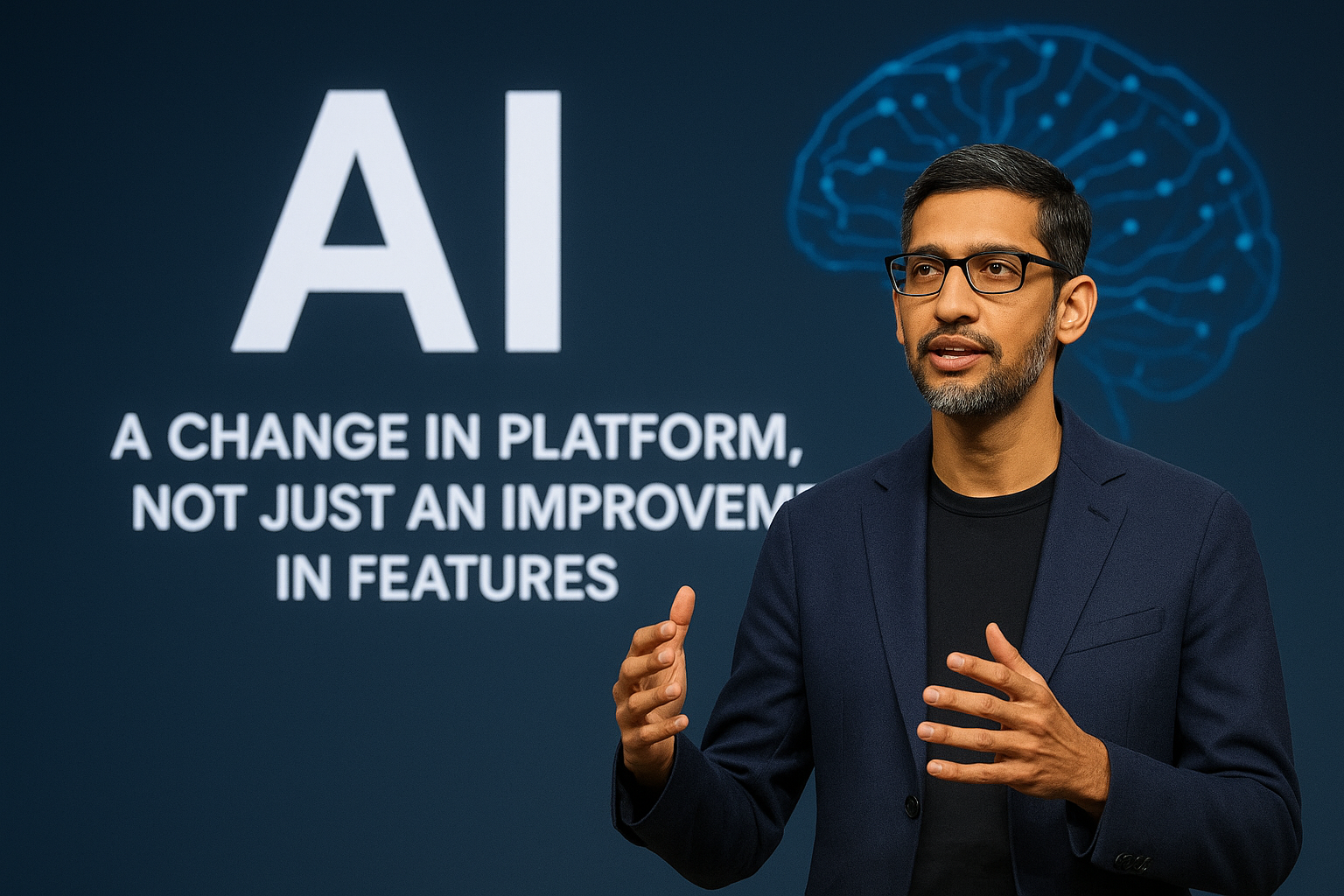
According to Sundar Pichai, AI will bring about significant changes over the next two to four years.
Few voices are as influential in the rapidly evolving field of artificial intelligence as Sundar Pichai, the CEO of Google/Alphabet. Sundar Pichai has given hints over the past year about how he believes AI will change Google’s main products and the direction of technology in general over the next two to four years. According to his comments, a paradigm shift from small improvements to fundamental change is imminent.
Here’s a closer look at what Sundar Pichai says will happen in the next two to four years as a result of AI, what Google is doing to get ready for it, and what this means for developers, users, and the competitive environment.
A Change in Platform, Not Just an Improvement in Features Pichai Sundar
Sundar Pichai has frequently described AI’s role in the upcoming years by framing it as a platform shift. Recent reports state that he sees the introduction of generative AI and sophisticated models as technology that will make decades of research into usable consumer and business products, rather than merely as new features.
Expectations are high because what appears incremental today could be a component of a complete overhaul of the way we use computers, tools, and the internet.
Imntporta Ideas in Sundar Pichai Vision


Several recurring themes about the changes Pichai anticipates AI bringing come from his conversations with staff, public statements, and product signals. The main ones are listed below:
1. Search turns into an AI-powered assistant Sundar Pichai
Google Search will “change profoundly” in 2025 and beyond, according to one of Sundar Pichai most frequently made predictions. Instead of seeing search as a collection of blue links, he sees it as a multi-modal, conversational assistant that can respond to increasingly complicated user enquiries.
According to this vision, Sundar Pichai:
- Context, nuance, multi-step questions, and follow-up queries will all be better understood by search.
- The goal of Google’s internal initiatives, such as Project Astra (which handles audio and video inputs) and Gemini Deep Research (which automates long-form research), is to enhance the depth of search’s response.
- Concise AI-generated summaries, or “AI Overviews,” will become more prevalent, making it easier to navigate through more links.
- Tests are already underway for Search’s “AI mode,” which provides conversational, chatbot-like interactions. It’s a “complete reimagining of search,” according to Google.
The objective, according to Sundar Pichai, is for Search to address more difficult queries than in the past.
2. Everything, including your browser, tools, and apps, has AI built in, Sundar Pichai.
According to Sundar Pichai predictions, AI will be integrated into daily life rather than existing as an add-on:
- Chrome + Gemini: Google is integrating its Gemini model into the Chrome browser, introducing AI features like content summarisation, safer browsing, and assistive suggestions straight into the online space.
- Sundar Pichai has pledged to incorporate AI features more thoroughly and widely throughout Google’s product stack, which includes Search, YouTube, Cloud, Android, Pixel, and more.
- Subscriptions for sophisticated AI tools: Google has started providing power users with access to premium AI features.
- Agents that act on your behalf: Google is working on creating AI agents, such as Project Mariner, that are capable of performing tasks autonomously, like making travel arrangements, conducting research, or navigating apps.
The goal is for AI to be “under the hood” of almost every Google product (and probably many third-party tools) over the course of the next two to four years—not as an add-on feature, but as a fundamental component.
3. Sundar Pichai: tighter integration and quicker iteration from models to products
Pichai has underlined that Google needs to provide a more smooth transition between its AI models (such as Gemini) and actual consumer/business products in order to facilitate this kind of change:
- Koray Kavukcuoglu, formerly of DeepMind, was recently elevated by Google to head product development for AI. The goal of his new position as Chief AI Architect is to guarantee that models and product features are more closely aligned.
- Faster iteration of AI-powered features is being pushed, which will make models more effective, leaner, and user-responsive.
To put it another way, the development cycle will increasingly integrate model design, product design, and deployment from the beginning, all with an emphasis on actual user problems, as opposed to creating a model separately and then considering how to use it.
4. Increased productivity and human-AI cooperation Sundar Pichai
According to Pichai and other Google executives, AI will increase knowledge workers’ and engineers’ productivity by about 10% by managing repetitive tasks and freeing up more time for strategy and creativity.
His message remains constant: AI is intended to supplement human expertise, not to replace it, at least for the foreseeable future. This viewpoint, which challenges the notion that AI will merely replace jobs, is shared by Google’s leadership.
This actually means:
- More help is provided to developers (code completion, debugging, scaffolding).
- Intelligent draughting, summarisation, and ideation tools are provided to analysts, writers, and creators.
- Researchers, support personnel, and many other roles switch from “either/or” to “AI + human” workflows.
5. Sundar Pichai’s competitive acceleration and urgency
Pichai frequently emphasises the importance of 2025 and the ensuing years. He issues a warning about “disruptive moments” and the escalation of competition in the fields of regulation and generative AI.
Google is investing more in infrastructure, hiring, and team alignment in order to succeed in what it refers to as the “AI platform shift” in light of this urgency.
Effects and Difficulties
Many of the changes outlined in Pichai’s vision are already underway, so it’s not just aspirational. However, there are risks and ramifications as well.
For users


More useful and intelligent tools:
- Tasks like creating drafts, organising itineraries, and summarising lengthy articles could become almost instantaneous and integrated into commonplace tools like search, email, and browsers.
New paradigms for interactions:
- Users can write or speak in conversation and receive multi-step assistance without the need for separate apps.
More individualised encounters:
- Deep integration of AI could allow for more dynamic adaptation of actions, reminders, and suggested content to individual patterns.
For startups and developers
New area of opportunity:
- Developing vertical, domain-specific AI agents or plug-ins could be a significant growth area as AI turns into a platform.
A higher standard for product work
- Product teams will need to consider model scaling, latency, safety, context, and user experience more carefully due to the tighter integration with large models.
Ecosystems are more important:
- Interoperability, API access, partnerships, and plug-in systems will all become essential competitive levers.
For companies and businesses
Transformation of workflow:
- Numerous knowledge-intensive, creative, legal, and back-office processes will be redesigned to make use of AI assistants.
Pressures from infrastructure and costs:
- Businesses will require strong compute, data pipelines, and engineering talent to implement and maintain AI-driven features at scale (with speed, latency, and privacy).
Privacy, safety, and trust:
- These will no longer be negotiable. Institutions will demand transparency, auditability, and safeguards as AI automates more tasks and interacts with user data.
Hazards and obstacles

Bias, errors, and hallucinations:
- Errors could have more serious repercussions as AI grows more independent.
Energy, compute cost, and latency:
- Scaling real-time, responsive AI is costly and technically challenging.
Policy and regulation:
- Businesses need to be prepared as governments examine AI more closely for false information, fairness, privacy, and competition.
Business model disruption:
- For instance, if AI “overviews” decrease clickthroughs, website publishers who depend on search traffic may see a decline in revenue.
Looking Ahead: Sundar Pichai’s Focus for the Next 2 to 4 Years
Years 1 and 2
- AI Mode in Search is made widely accessible (launch in the US is in progress).
- incorporating Gemini-like models into Google’s main services (such as Gmail, Chrome, and Search).
- Agent prototypes (Project Mariner, Astra) start limited testing.
- Faster AI feature development cycles and closer collaboration between the product and model teams
- Some users and businesses start to notice quantifiable increases in productivity.
Years 3 and 4
- Multi-step, conversational AI assistants are becoming ubiquitous in browsers and search engines.
- AI agents that are capable of performing tasks (like booking and planning) on their own are more dependable and have a wider range of applications.
- AI-first workflows are adopted by many vertical sectors.
- People’s habits are changing; they now anticipate AI assistants and natural language interfaces in all digital services.
- Businesses without AI cores lag as competition heats up.
By upgrading its infrastructure, hiring top talent, and making investments in safety, ethics, and model efficiency, Google will work to maintain its position as a leader during this time.