Deadlocks in Senate Government Shutdown Votes Raise the Stakes in Washington
Washington, D.C. The Senate’s repeated roll calls to approve (or block) funding bills that would reopen the government are drawing more and more attention as the U.S. federal government enters its third week without full funding. Every vote demonstrates the political deadlock, the leverage tactics of each party, and how precarious the future has become.
The senate government shutdown vote is currently at a standstill.


When Congress failed to pass a continuing resolution to extend funding, the shutdown started on October 1, 2025, at 12:01 a.m. EDT. Since then, Democrats who insist on including health care provisions have blocked the Senate’s repeated attempts to advance funding bills, which are usually passed by the House.
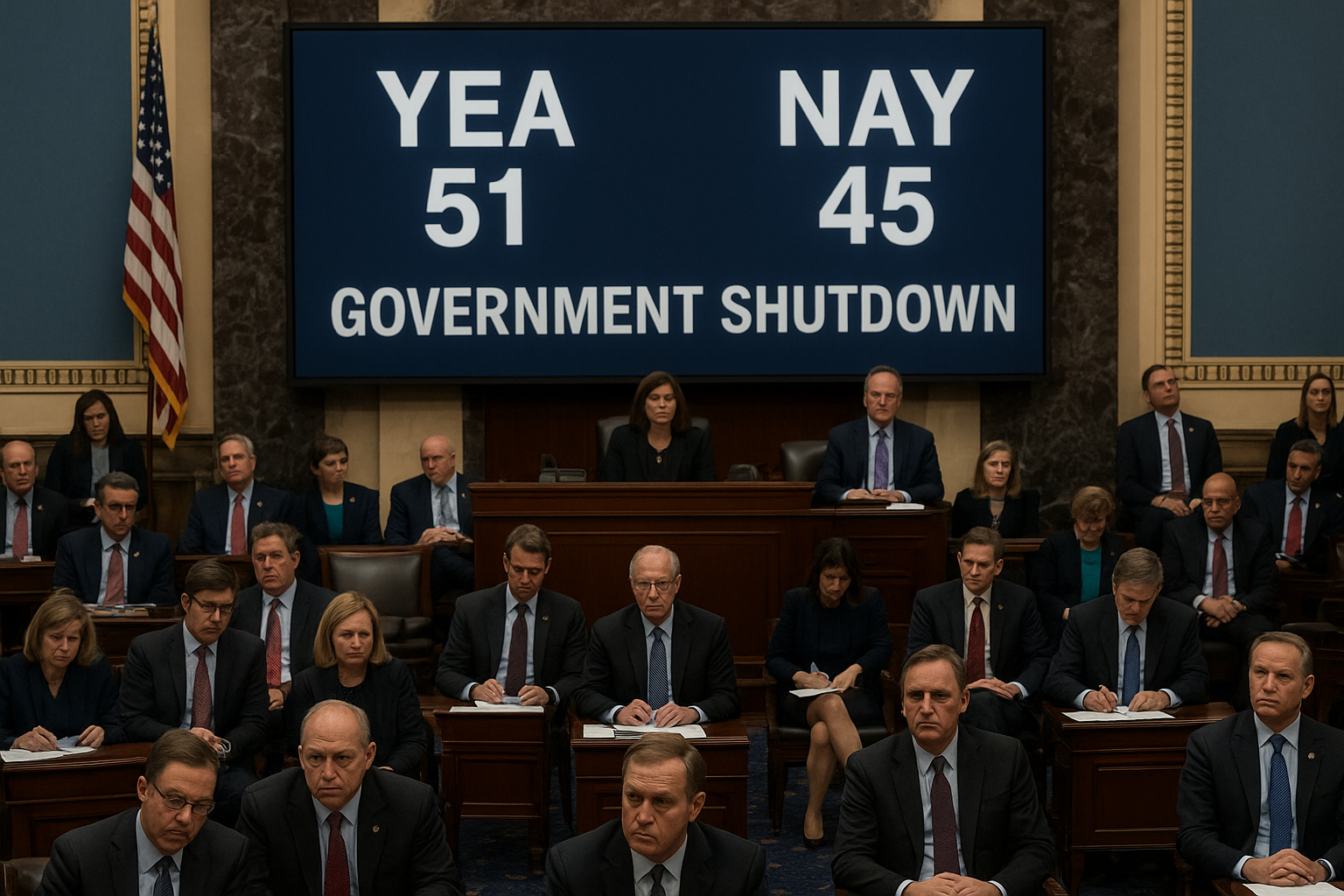
For the tenth time by October 16, the Senate had failed to move the funding resolution supported by the Republican Party. The vote was 51-45, far less than the 60 votes needed to proceed under Senate rules.
To at least restore military funding, Republicans attempted a different strategy in parallel: a procedural push to advance a full-year defence appropriations bill. Even that measure was unsuccessful. Also falling short of the 60-vote threshold, the defence funding vote was 50–44. Just three Senate Democrats—Senators Catherine Cortez Masto, John Fetterman, and Jeanne Shaheen—broke ranks to back it.
The senate government shutdown vote has thus turned into a daily gauge of how impassed the two parties are, with Democrats demanding “must-have” health care demands as part of any solution and Republicans pushing to reopen government.
What’s Causing the Deadlock? senate government shutdown vote


1. Filibuster threshold and rules of procedure
- Republicans cannot use their current majority to advance funding alone because Senate rules require a 60-vote supermajority to end debate (invoke closure). They need to gain some Democratic support, which they haven’t done at all thus far. This has angered Senate Republicans, who have accused Democrats of “filibustering by default.”
2. Democrats’ demands for health care
- Democrats demand that any funding bill reverse recent Medicaid cuts and extend the expanded premium subsidies under the Affordable Care Act (ACA). They contend that millions of Americans will experience sharp increases in the cost of health insurance in the absence of such safeguards.
- Republicans argue that health care talks ought to wait until the government reopens and decline to make any promises about the results up front. While the government is closed, Senate Majority Leader John Thune has offered to ensure Democrats a vote on extending subsidies, but he has declined to negotiate terms or bind the outcome.
3. Public pressure and political clout
- Democrats see the shutdown as a tool to pressure Republicans into addressing urgent and politically popular healthcare issues in the run-up to the elections. Several progressive leaders have cautioned against caving in to Republican timing.
- Republicans, on the other hand, claim that Democrats are purposefully preventing reopening in order to gain political advantage. For instance, on September 19, after Senate Democrats rejected a previous stopgap funding measure, President Trump publicly blamed them.
- The public’s perception is changing. 89% of Americans consider the shutdown to be a problem, with 54% considering it a major problem, according to a recent AP–NORC poll conducted from October 9–13. The blame is divided: 54% point the finger at congressional Democrats, 58% point the finger at Trump, and 58% point the finger at congressional Republicans.
4. The price and human cost
- Numerous federal services are disrupted by the shutdown. There are hundreds of thousands of federal workers who are either working for free or on furlough. Agencies are reducing or postponing their operations. According to a recent estimate by the White House budget office, it costs roughly $6.5 billion to cover one pay period.
- The Pentagon has been directed by President Trump to use available funds to pay active-duty military personnel. Additionally, some law enforcement and essential functions have been categorised as “exempt” by agencies, which promise back pay or “super checks” to make up the difference later.
Key Players and Vote Patterns in the Senate Government Shutdown Vote

Lineups and defections have been made public by the Senate government shutdown vote:
- Almost all Democrats are against the continuing resolution that was passed by the House. Senators Fetterman, Cortez Masto, and occasionally independent King are among the few Democrats who have voted with Republicans.
- The same three Democrats defected to support Republicans on the procedural vote on defence appropriations.
- Sen. Rand Paul, who deviated from GOP leadership, was one of the Republicans who dissented from party discipline.
Republican Senate leader Thune has been irritated. “If anything was needed to demonstrate just how fundamentally uninterested Democrats are in supporting our troops … look at this vote,” he said on the Senate floor following today’s failed defence vote.
Chuck Schumer, the Senate minority leader, retorts that Republicans haven’t presented a compelling plan. Additionally, he has stated, “We’re not negotiating in public,” refusing to engage in public negotiations. It’s that simple.
In an interview, Senator Mark Kelly contended that a comprehensive package is required to end the shutdown and that a vote on health care subsidies alone would not be sufficient.
What Takes Place Next? senate government shutdown vote
Several potential futures are on the table, with no definitive resolution in sight:
More votes, more diversity
- Senate leaders might keep rewriting funding bills, removing or adding riders, trying mini-packages, and experimenting with bipartisan compromises.
A compromise agreement:
- Both sides’ negotiators may reach an agreement that combines Republicans’ insistence on a clean reopening with Democrats’ demands for health care. But time is running out and trust is low.
Increase in the severity of the consequences:
- Political pressure increases, services are more severely impacted, and federal employees’ financial stress increases as the shutdown continues.
Administrative or judicial actions:
- In order to maintain essential operations, agencies may try creative accounting or fund reallocation, but these strategies are contentious and subject to legal challenges. Some lawsuits may also surface.
Record shutdown risk:
- The modern record was set by the 35-day shutdown in 2019. The new shutdown may equal or exceed that duration if this standoff is not resolved.
The Significance of the Senate Government Shutdown Vote

The Senate government shutdown vote is significant not only for the legislative process but also for the political and substantive messages it conveys:
Credibility and leverage:
- Senators’ willingness—or lack thereof—to cross party lines reveals their priorities.
Stakes in health care and the public:
- The dispute is not just procedural; it is about policy that impacts the access to care, stability of coverage, and premiums for millions of Americans.
Senate rules under pressure:
- The frequent inability to reach closure highlights the depth of partisan divisions and the rarity of successful bipartisan cooperation.
Political risk in the future:
- Both parties run the risk of backlash as public opinion shifts. Republicans may view refusals to make concessions as heartless, while Democrats may view resistance to reopening as obstruction.
Institutional repercussions:
- A protracted shutdown increases cynicism about dysfunctional institutions and erodes public confidence in the government.
The Senate government shutdown vote in The Messaging Battle
Republicans’ position:
- Democrats are holding the government hostage for their partisan policy demands, obstructing even the most basic government operations. The need to “pass something” now and national security are priorities for Thune and GOP leaders.
Democrats’ position:
- The GOP’s “clean” funding proposals would expose vulnerable Americans to premium increases while ignoring critical health protections. Democrats claim they won’t back reopening until urgent health care needs are met.