Senate Probe Into Pam Bondi: Comey Indictment, DOJ “Weaponization,” and Epstein Files
Washington, D.C. This week, as senators prepare for a crucial hearing before the Judiciary Committee that could determine the next stage of the fight for the Department of Justice’s (DOJ) independence, Attorney General Pam Bondi is set to take centre stage on Capitol Hill. Both Republicans and Democrats view the DOJ’s handling of the Jeffrey Epstein investigation and the shocking recent indictment of former FBI Director James Comey as flashpoints that demonstrate whether justice in the current administration is motivated by politics or the Constitution. Her testimony is anticipated to delve deeply into these issues.
Political Crosshairs: The Significance of Pam Bondi’s Hearing
Pam Bondi is making her first appearance before the Senate Judiciary Committee since being confirmed, and it comes at a contentious time. Republicans promise to applaud her for bringing accountability back, while critics charge her with leading a DOJ that is being used more and more to target former opponents of President Donald Trump.
This hearing is an opportunity for Democrats to question whether Pam Bondi’s Justice Department has turned into a political tool. She will be questioned about what they describe as a pattern of prosecutorial decisions that target political opponents, the mass resignations of career staff who defied orders aligned with Trump, and the opaque handling of sensitive files, particularly those related to Epstein.
In order to present this hearing as a discussion of competence rather than politics, Pam Bondi, a Republican, might highlight her administration’s initiatives to combat violent crime, enforce immigration laws, and hold influential officials accountable.


What Senators Want to Know About the Epstein Files
Pam Bondi’s handling of the files from the Jeffrey Epstein investigation will be one of the most controversial topics. There has long been conjecture regarding which public figures might have been involved in Epstein’s trafficking ring and high-profile connections, as well as whether or not investigations were stifled or concealed.
DOJ and FBI officials refused to make more files public in July, claiming that no fresh evidence had surfaced that would implicate others or allow Epstein to continue abusing his position. The decision caused a lot of backlash, particularly from Democrats who accused the administration of protecting allies and conservative commentators who called for more disclosure.
Senators will probably question during the hearing:
- What particular factors were taken into consideration when deciding which files to withhold?
- if the documents were redacted or purified of Trump or anyone else connected to Epstein.
- if the DOJ or Pam Bondi got involved in any decisions involving disclosures to the public.
- How the DOJ plans to strike a balance between the demands for transparency from victims and concerns about confidentiality or national security.
Democrats are especially inclined to accuse others of obstruction or concealment, claiming that denying full release amounts to concealing politically awkward facts. In order to demonstrate that she is not the gatekeeper of secrecy, Pam Bondi must proceed with caution.
A High-Profile Test Case: The Comey Indictment
The indictment of former FBI Director James Comey adds even more significance to the hearing. Comey was charged by a grand jury in the Eastern District of Virginia in late September 2025 with two counts: obstruction of a congressional proceeding and making false statements to Congress. Pam Bondi signed the DOJ’s public statement, which praised it as proof that “no one is above the law.”
However, there is political and prosecutorial drama beneath the headline:
- According to reports, senior career prosecutors in Virginia had decided the evidence was insufficient and had refused to pursue the case.
- Trump stepped in and replaced the U.S. Attorney there (Erik Siebert), who was alleged to have reservations, with a former lawyer who was close to Trump, Lindsey Halligan.
- Halligan moved quickly to indict Comey.
- Notably, a third proposed false-statement count was not included in the indictment.
- Fears of politicised purges have increased as a result of DOJ’s recent wave of firings and sudden resignations in the national security offices in the Eastern District, including Michael Ben’Ary.
- An FBI agent who declined to help with a proposed “perp walk” of Comey was suspended in a startling move.
The whole picture begs the question: Did Pam Bondi’s DOJ pursue the Comey case as a political statement rather than due to strong evidence?
Senators will probably question Pam Bondi during the hearing about:
- Whether she participated in the Comey prosecution or gave her direct approval
- Her reaction to accusations that the case was weak and was only being pursued because of political pressure
- The selection procedure for Halligan and the handling of any oversight or recusal
- The wider message about DOJ impartiality conveyed by prosecuting a former FBI director
- whether similar patterns of political targeting are being followed in other cases (such as the investigations into Letitia James, Adam Schiff, and Andrew Cuomo).
Pam Bondi will need to walk a tightrope between protecting the DOJ’s authority to go after influential people and denying that it is the White House’s law enforcement branch.


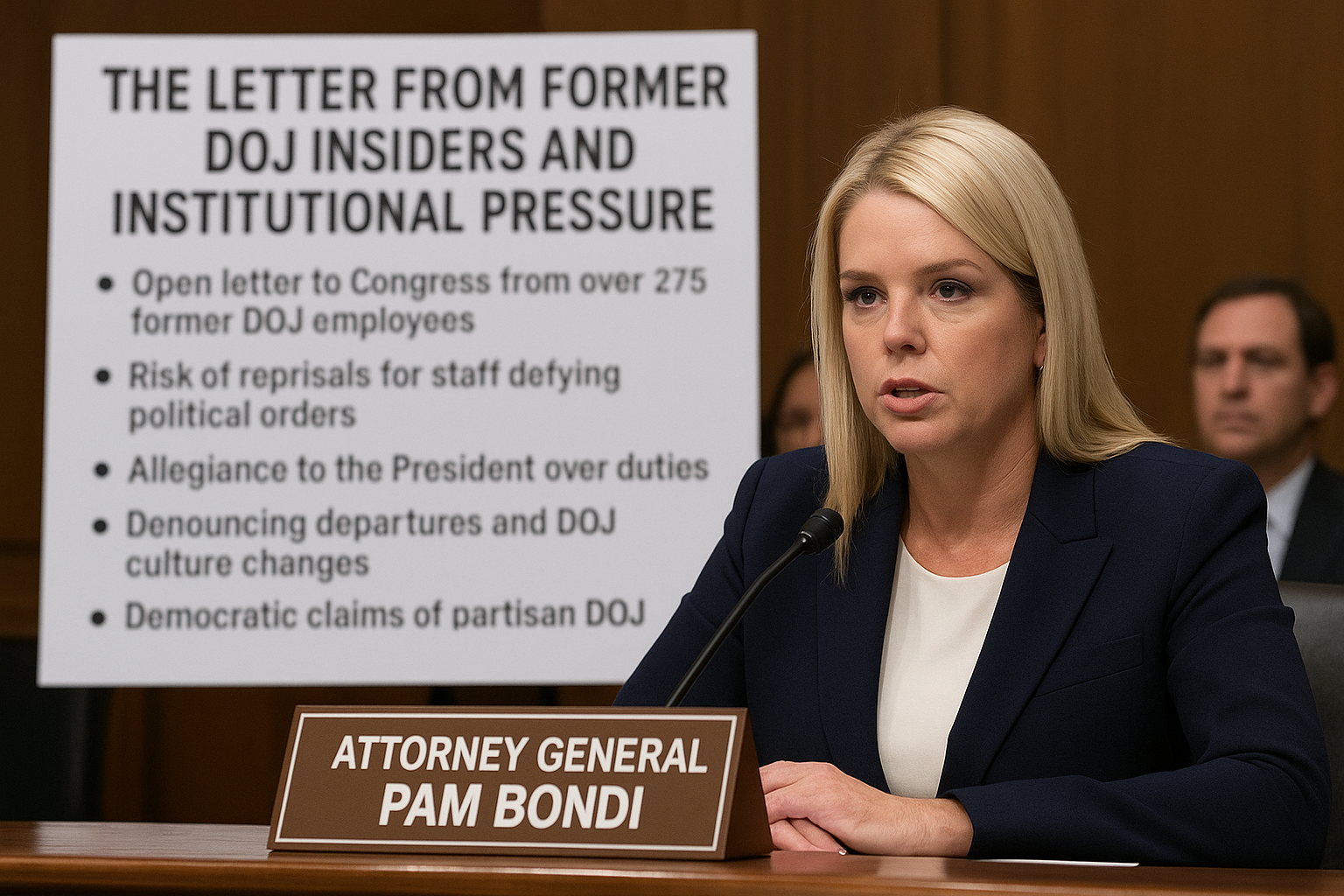
The Letter from Former DOJ Insiders and Institutional Pressure
More than 275 former DOJ employees wrote an open letter to Congress calling for more oversight prior to the hearing. They cautioned that staff members who defy political orders risk a hostile environment of reprisals and that allegiance to the president is being prioritised over moral and constitutional duties.
These former officials, who included judges, prosecutors, and agents, denounced recent mass departures and described ongoing changes in DOJ culture as a danger to the agency’s fundamental purpose. Democratic claims that Pam Bondi’s DOJ is becoming more and more detached from conventional, nonpartisan standards are strengthened by their combined voice.
Things to Look for at the Hearing
Introductions —Pam Bondi’s opening remarks will probably portray her term as one of responsibility, combating crime, and stopping special interests from protecting wrongdoers. She will be expected to defend the Comey case as proof that everyone is subject to scrutiny.
Democratic Inquiry —Anticipate incisive questions regarding the Epstein file rulings, whether Trump or his associates were shielded, and whether the DOJ is becoming a political instrument.
Examining the Comey Indictment —Democrats will look into whether Pam Bondi overruled career objections and lied to Congress or the public about the case’s viability.
Resignations, Purges, and Staffing —Senators might question Pam Bondi about the number of seasoned prosecutors who were fired and whether loyalty or merit drove the selection of replacements.
Future Case Approach —Critics will question whether the same strategy is used in investigations into Trump’s alleged enemies, such as Adam Schiff and Letitia James.
Openness and Supervision —Senators have the right to request access to DOJ internal memos, White House correspondence, and prosecutorial decision-making standards.
Bondi’s Rebuttals & Accommodations —Will she acknowledge her mistakes, make reform promises, or sidestep the issue by citing “activist protests” or “Biden DOJ excesses”?

What’s at stake: DOJ Erosion or Independence?
This hearing is not your typical congressional hearing. It might serve as a referendum on the DOJ’s moral character under Bondi. She might gain more independence and political protection if she is successful in defending her record. The hearing might spark demands for additional oversight, structural changes, or even the impeachment of Justice Department officials if she fails.
Republicans see Bondi’s performance as an opportunity to restore DOJ’s reputation and counter weaponization narratives. It’s a desperate attempt by Democrats and institutionalists to reiterate that politics cannot override the rule of law.