“GST सुधार: 22 सितंबर से लागू होंगे नए स्लैब, खाने-पीने की चीज़ें और रोज़मर्रा के सामान होंगे सस्ते”Nobel Peace Prize 2025: Pakistan Is Even More Hurt by Trump’s Loss
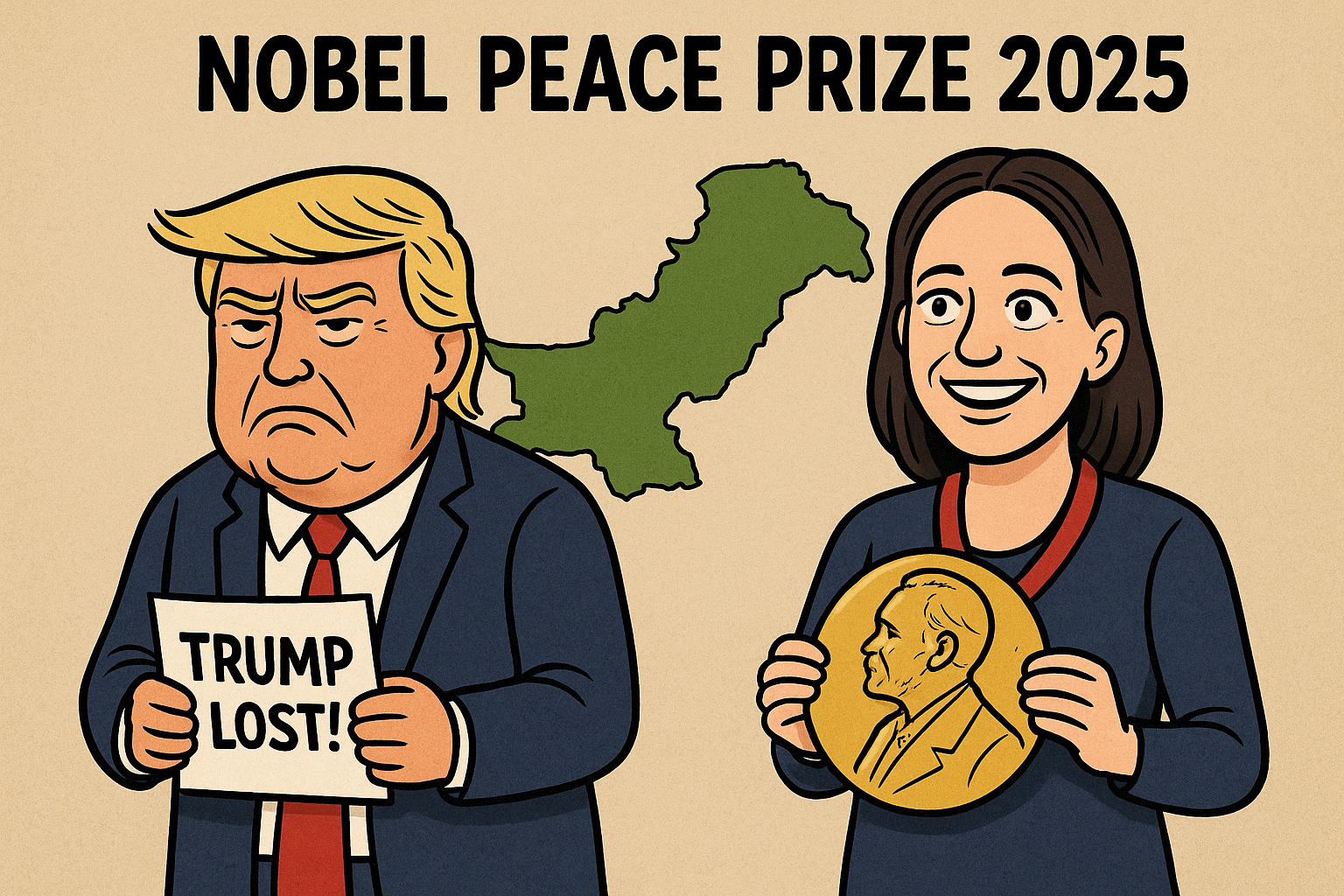
A dramatic symbolic moment occurred on October 10, 2025, when the Norwegian Nobel Committee announced that María Corina Machado had won the Nobel Peace Prize 2025. Many observers felt that the decision sent a clear message to certain states whose diplomatic calculations depend on their alignment with power brokers, as well as to world leaders vying for moral prestige.
The idea that Trump’s loss in the Nobel race will hurt Pakistan more than most is one of the more unexpected undercurrents in media commentary. At first, that might seem counterintuitive. However, the reasoning becomes more evident when you examine the current political dynamics between Pakistan, the United States, and regional diplomacy.


Pakistan will be more hurt by Trump’s ambition and his Nobel Peace Prize 2025 loss.
For a long time, Donald Trump has promoted the idea that he is a peacemaker and a dealmaker. He frequently praised ceasefire agreements and mediation efforts during his 2025 term, particularly in relation to the conflicts in Gaza and other places. He might be a serious contender, according to rumours that circulated in the lead-up to the Nobel announcement. Some even claimed that he had powerful supporters who were urging for his nomination.
However, he ultimately failed. Rather, the Nobel Committee recognised Venezuelan opposition leader María Corina Machado for her “unwavering efforts to advance democratic rights … and her fight for a fair and peaceful transition from dictatorship to democracy.” Trump’s team accused the Committee of choosing “politics over peace” as a result of the decision.
From an American perspective, Trump’s reputation as a statesman has been severely damaged by the rebuff. For reasons based on recent bilateral relations, expectations, and regional diplomacy, however, the ramifications are more acute and painful from Pakistan’s point of view.

Why Pakistan Will Not Win the Nobel Peace Prize in 2025
1. Pakistan’s Alignment and Leverage Investment in the United States for the Nobel Peace Prize 2025
- Pakistan has made an effort to rebalance its foreign policy over the last ten years by selectively siding with influential figures. The United States continues to play a crucial role in the world, and allied nations enjoy the prestige that results from perceived moral or diplomatic successes under U.S. leadership.
- Pakistan had hoped that by endorsing or appearing close to Trump’s agenda, it would be able to use that association to improve its own international standing, especially in the UN, with India, and in talks with other countries. Pakistan might have benefited from the symbolic boost if Trump had been awarded the Nobel Peace Prize.
- Pakistan loses that possible “soft prestige jackpot” as a result of Trump’s loss. Credibility, agency, and moral capital are all important on their own, and the snub highlights that Pakistan’s diplomatic calculations cannot be based solely on aligning with power.
2. Nobel Peace Prize 2025: Political embarrassment and unfulfilled expectations
- In certain Pakistani circles, such as among diplomats, analysts, and the media, there were hopes that Trump’s alleged ability to broker peace would result in official recognition. The Nobel contest was actually flagged by Pakistani media outlets, which also conjectured about how a Trump victory might improve Islamabad’s reputation. That sentiment is reflected in the headline, “Nobel Peace Prize 2025: Trump lost – why the defeat will sting Pakistan more.”
- In areas that had publicly or semi-publicly courted the expected outcome, the fallout is frequently more severe when those expectations are not fulfilled. Pakistan now has to deal with the shame of having wagered on a leader who was unable to win the prize, either symbolically or rhetorically.
3. The Nobel Peace Prize 2025 for Political Narratives and Domestic Criticism
- Foreign policy and alliance strategy frequently become topics of discussion in Pakistani domestic politics. The Nobel result could now be used as a talking point by opponents and opposition parties: “You supported Trump, but he lost — what did Pakistan gain?” It turns out that there were no significant symbolic benefits to Washington’s patronage.
- This is particularly true in a nation where national symbolism and prestige are highly valued in the national conversation. Critics can take advantage of the claim that Pakistan had symbolically and diplomatically backed a losing horse.
4. The Nobel Peace Prize 2025 for Moral Authority and Diplomatic Posture
- In international diplomacy, having a Nobel laureate as a relative or having won one yourself can confer moral authority. When it comes to issues like climate change, security, humanitarian concerns, Kashmir, and more, Pakistan has frequently attempted to position itself as a spokesperson for Muslim or developing world interests. That was achieved by siding with someone like Trump (in the hopes of gaining moral legitimacy in the future).
- But now that Machado has won the Nobel Peace Prize 2025 and Trump has lost, the moral focus is on Machado’s resistance to authoritarianism. The message becomes more obvious: democracy, human rights, and activism are important. When compared to a Nobel Peace laureate who fought against dictatorship, Pakistan’s own struggles in these areas become more apparent.
5. The Nobel Peace Prize 2025 for Regional Diplomacy & Rival Narratives
- The geopolitics of South Asia are competitive. States use international honours to enhance their narratives, as seen in Bangladesh, India, and even Sri Lanka. Pakistan now loses a potentially difficult-to-rival diplomatic talking point that it could have used to highlight its position as a regional stakeholder with close ties to Washington.
- Furthermore, Pakistan could have used its affiliation with a “peace-prize winner” to counterbalance critical narratives in any future messaging contests, such as blaming India for a conflict or defending its regional posture. That’s a weaker option now.

Limitations and Rebuttals to the Sting Nobel Peace Prize 2025
The notion that Trump’s Nobel loss “will sting Pakistan more” is, to be fair, a bit rhetorical and speculative. There are significant rebuttals:
Pakistan and the United States have a complex relationship.
- They are not based on symbolic rewards, but rather on connections in trade, aid, security, and strategy. Those foundations are not undermined by the Nobel award.
Symbolism’s actual impact is limited.
- International prestige is ephemeral and brittle. The true test is found in defence cooperation, investments, and policy results, among other things. Policy loss is not always the result of a Nobel snub.
In a subsequent year, Trump could still win.
- Many believe he might run again in 2026, particularly if peace agreements or ceasefires hold. Associations might resurrect if that occurs.
There are internal problems in Pakistan.
- Its development metrics, democratic record, human rights record, and soft power might be more significant than its symbolic association with a single world leader.
What This Signifies for Pakistan’s Future Nobel Peace Prize 2025
Rethink Your Dependency on Symbolic Alignment
- Pakistan should refrain from depending too much on symbolic alliances with leaders who might or might not provide moral capital. Rather, it must build its own credibility by making investments in development, human rights, diplomacy, and strategic autonomy.
Refrain from overselling links in public.
- Overtly publicising alignment through public posturing (e.g., “We back him, we nominated him, we expected he’d win”) creates expectations and, as a result, invites harsher criticism if those expectations are not met. It might be better to use discretion.
Encourage Self-Reliant Storytelling
- Pakistan ought to spend money on diplomacy and narratives that don’t rely on outside approval. Its profile can be raised on its own, for instance, by supporting regional connectivity, humanitarian efforts, climate leadership, and mediation roles.
Control the Conversation at Home
- The Pakistani government should actively manage the narrative, focussing on actual accomplishments, avoiding overhyping the association, and framing the loss as external, since the Nobel snub might become a talking point in domestic criticism.