What are the protests known as “No Kings”?
At their core, the “No Kings” protests are a nationwide (and to some extent international) set of demonstrations that oppose what organisers call the slide towards authoritarianism in the United States under the second presidency of .
The following are some important facts:
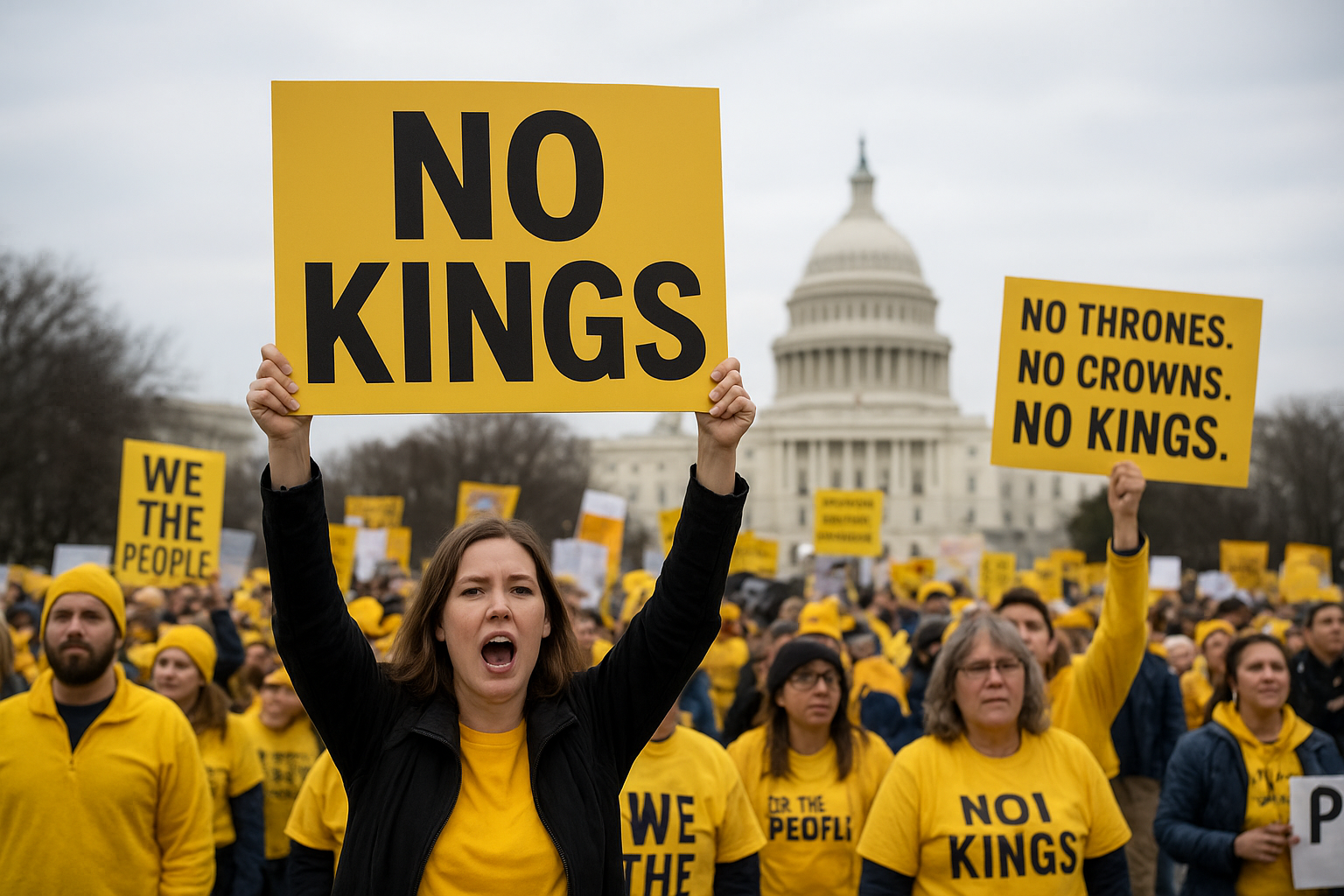
- “No Thrones” is the tagline. Not a crown. No Kings. According to their official website, “On October 18, millions of us are rising again to show the world: America has no kings, and the power belongs to the people.”
- The first significant protest wave occurred on June 14, 2025, which also happened to be President Trump’s 79th birthday and the day of the U.S. Army’s 250th anniversary parade. The date, according to the “No Kings” organisers, was symbolic: a protest against alleged executive overreach, militarisation, and self-aggrandizement.
- More than 2,500 events are planned in all 50 states for the second major wave, which is set for October 18, 2025.
- The movement’s stated stance is largely non-violent; its organisers place a strong emphasis on “know your rights,” de-escalation training, abstaining from weapons, and lawful protest.
It’s a massive, multi-city protest movement against what participants perceive as threats to democratic norms, specifically the erosion of civil liberties, militarised policing, dissent suppression, and executive branch overreach.


For what reason are people demonstrating? Which triggers are involved? No Kings
A number of issues come together to form the “No Kings” protests. The main themes are as follows:
1. Executive overreach and authoritarian tendencies
- According to organisers, Trump’s second term has seen an increase in executive power, including the use of armed forces in urban areas, ruthless immigration raids, actions against critics and journalists, and a merging of spectacle and government. The American Civil Liberties Union, for instance, reports that during his first nine months in office, the administration “has abused their power to attack our neighbours and communities, suppress free speech, and create a climate of fear.”
- Protesters are uniting behind the slogan that “the US is sliding into authoritarianism and there should be no kings in the US,” according to The Guardian.
- The question of whether protests alone can stop what detractors claim is democratic backsliding is brought up in another Financial Times commentary.
2. The aesthetics of power and militarisation
- Many viewed the June protests as an ostentatious display of power because they were scheduled to coincide with a military parade honouring the anniversary of the U.S. Army. This was seen by the “No Kings” movement as a component of a larger effort to use imagery reminiscent of monarchy.
- Additionally, the claim that the executive is eschewing local authority and civil norms has been strengthened by the National Guard’s and other federal forces’ deployment into cities like Los Angeles, Chicago, and Washington, D.C., to quell protests and preserve order.
3. Immigration, civil liberties, and law enforcement
- The movement is based on civil rights concerns, such as the treatment of immigrant communities, the policing of dissent, and the potential vulnerability of journalists and activists. The ACLU’s “Know your rights” resources, for instance, promote readiness when confronted with threats from ICE or law enforcement.
- It also connects social justice, labour rights, and economic issues: the Guardian noted that “a voice in democracy creates power for regular folks,” highlighting how powerful US labour unions are igniting the protests.
4. Symbolic claim
- Intentionally evocative, the protest slogan “No Kings” opposes monarchy, a single strong leader, and the idea that power belongs to the people in a democracy. The visual message is reinforced by the use of symbolic colours, such as yellow ribbons of hope and Hong Kong umbrellas, which encourage protesters to wear yellow to show solidarity.
5. Partisan tension, the shutdown, and the political environment
- The protests also take place against a backdrop of increased partisan tensions, including intra-party strife, a federal government shutdown, increased rhetoric about “antifa” and foreign influence, and concerns about tainted elections. Republicans have attempted to characterise the demonstrations as anti-patriotic, un-American, and associated with extremist groups.
The “No Kings” protests are a broad protest movement against what participants believe to be a democratic system under threat, one that is based on executive power, weak institutions, militarised policing, social injustice, and symbolic authoritarianism.
Who is planning and taking part? No Kings


Partners and organisers
The main groups behind “No Kings” are:
- — a community-based progressive advocacy organisation
- (ACLU) — offering resources for safety and protest rights.
- — shows up as the main organising coalition.
- The Guardian reported on the involvement of major labour unions like the SEIU and AFT, as well as the framing of democracy and labour voice.
The organisers estimate that over five million people participated in the June protests in over 2,100 cities and towns.
Engagement and grassroots No Kings
- Instead of relying solely on centralised leadership, the movement emphasises grassroots mobilisation, including ordinary citizens, volunteers, and local event hosts. “Millions of regular Americans… took to the streets and declared with one voice: No Kings,” according to their website.
- Young activists and seasoned civil rights demonstrators are among the participants, with one 75-year-old organiser in Chicago remarking, “We didn’t want kings then, and we don’t want kings now.”
- The purpose of the spectacle and visual language (yellow clothing, signage, and decals) is to bring people from different cities together.
Scale of estimation No Kings
All 50 US states will host between 2,500 and 2,700 events on October 18.
The organisers are hoping to surpass the June turnout threshold; the possibility of “millions” of protesters is often mentioned.
According to some reports, the June demonstration might have been among the biggest one-day demonstrations in American history.
What are No Kings’ key takeaways and strategies?

Messages
“No Kings”:
- In democratic America, the term itself serves as a symbolic rejection of monarchy-style governance and the idea of a single “king.”
Put on yellow:
- a symbol of solidarity that is connected to other movements for democracy around the world.
Civil rights and nonviolence:
- Lawfulness, know-your-rights, de-escalation, and the absence of weapons are emphasised.
People-power:
- the knowledge that “power belongs to the people,” not to an unaccountable executive or a monarch.
Framing for broad justice:
- The movement places the protest above partisan or single-issue activism by tying together civil rights, worker rights, immigration rights, policing, and dissent suppression.
Strategies
Mass mobilisation:
- Thousands of events in towns, cities, and small towns.
Events hosted locally:
- The goal is distributed rather than concentrated in one large location, like Washington, DC.
Instruction and equipment:
- Trainings in media, digital engagement, protest rights, and safety are offered online. Trainings in interfaith solidarity and protest safety, for instance, are listed on the official website.
Symbolic images:
- Banners, human chains, marches, and signs such as “WE THE PEOPLE” and “No Kings” are all examples of the use of yellow.
Media strategy:
- utilising civil-society communication, solidarity networks, and national alliances.
Non-violent discipline contingency:
- The organisers seem eager to stress non-violent discipline and de-escalation in light of violent or confrontational incidents at previous protests.
Reactions: Encouragement + Criticism No Kings

Voices of support
- Rights groups and civil liberties: The movement is presented as defending First Amendment rights and aimed at preventing the abuse of power, according to the ACLU’s live coverage and “Know your protest rights” resources.
- According to the Guardian, labour leaders frame it in terms of democratic participation, freedom, and voice: “We and labour understand that you need to have a voice to have freedom.”
- Participants: It emphasises the continuation of protest traditions by involving both younger activists and older civil rights veterans (e.g., the 75-year-old organiser who referenced his 1960s roots).
Scepticism and criticism
Known as “hate America” or “un-American”: House Speaker and other Republican leaders have openly referred to the demonstrations as “Hate America” rallies and implied that they are in line with antifa or pro-Hamas activism.
Radical group concerns: Some reports indicate that socialist organisations and anti-Israel contingents, known as “Palestine Labour Solidarity,” are present at the demonstrations. Fox News, for instance, asserted that radical anti-Israelists are joining “No Kings.”
Evaluation of effectiveness and strategy: Despite being symbolic, protests may not result in tangible political change, according to the Financial Times and others. This is especially true given the movement’s decentralised structure and emphasis on liberal strongholds.
Safety and law enforcement issues: Concerns about potential violence, altercations, agitator infiltration, and the reaction of state and federal agencies arise during such sizable gatherings. A “crowd-for-hire CEO” warns of agitators being paid, according to Fox News.
Partisan rhetoric and polarisation: Critics contend that rather than forming broad coalitions, the movement may alienate moderate or rural voters because it is essentially partisan (targeting Trump).
State/government reaction
- Large-scale police or National Guard deployments are being planned by a few states. The governor of Texas, for instance, declared that the Texas National Guard and other law enforcement forces would be sent to Austin for the event.
- The deployment of federal troops or guard members in specific cities is being challenged in some federal courts.
Hazards
Escalation, violence, and counter-protests: Despite the organisers’ emphasis on nonviolence, there is always a chance that large-scale protests will clash with law enforcement, opposing demonstrators, or rogue actors. There have reportedly been instances of drivers hitting protesters during earlier demonstrations.
Outside actors or infiltration: allegations that the movement might be abused by paid agitators or outside influence. This is cautioned about in the Fox News article that quotes the CEO of crowd-for-hire.
Over-broadness and dilution of messaging: It’s difficult to keep a consistent message when there are thousands of local events and a large coalition. Critics claim that beyond opposition, there are no explicit policy demands. This is emphasised in the FT article.
Risk of backlash and branding: The demonstrations might be portrayed negatively and the cause could be undermined if they turn violent or are poorly run. This risk includes the Republican branding of rallies as “hate America.”
Gap in effectiveness: It’s one thing to rally a lot of people, but another to bring about long-lasting change (such as changes in policy or election results). Protests need to turn momentum into political power, as the FT article says.
Important disputes
Radical components embedded: Questions concerning coalition dynamics and message control are raised by the allegation that socialist or anti-Israel contingents are using “No Kings” to further their goals.
Funding and charity/non-profit status: According to Fox News, 501(c)(3) non-profits might be organising partisan protests, which is prohibited by US tax law.
Use of substance versus symbolism: Despite the potency of the symbolism, some analysts contend that protests without a plan for follow-up could only result in catharsis rather than change.
State oppression: Concerns about civil liberties are also raised by the National Guard’s deployment, law enforcement anxieties, and the possible repression of dissent. This is viewed by the movement as a component of the authoritarian slide.
Conclusion No Kings
With thousands of locations and millions of participants, the “No Kings” protests are among the biggest and most ambitious nationwide protest mobilisations in the United States in recent years.
They have a broad message: they oppose authoritarianism, defend civil liberties, oppose executive overreach, and assert people power against spectacle and monarchy symbolism.
In addition to the movement’s strong organisational backing from the ACLU, Indivisible, and labour unions, there are risks associated with it, including dilution of the message, backlash, state crackdowns, infiltration, and the potential for turning protest into policy.
Long-term influence of the movement will probably depend on how the October 18 event plays out in terms of attendance, nonviolence, media coverage, and government reaction.
“No Kings” is a flashpoint for observers of American politics, civil society, protest movements, and democratic health. In addition to revealing public opinion, it also shows how protest and mobilisation are changing in a high-stakes, highly politicised, media-dominated setting.