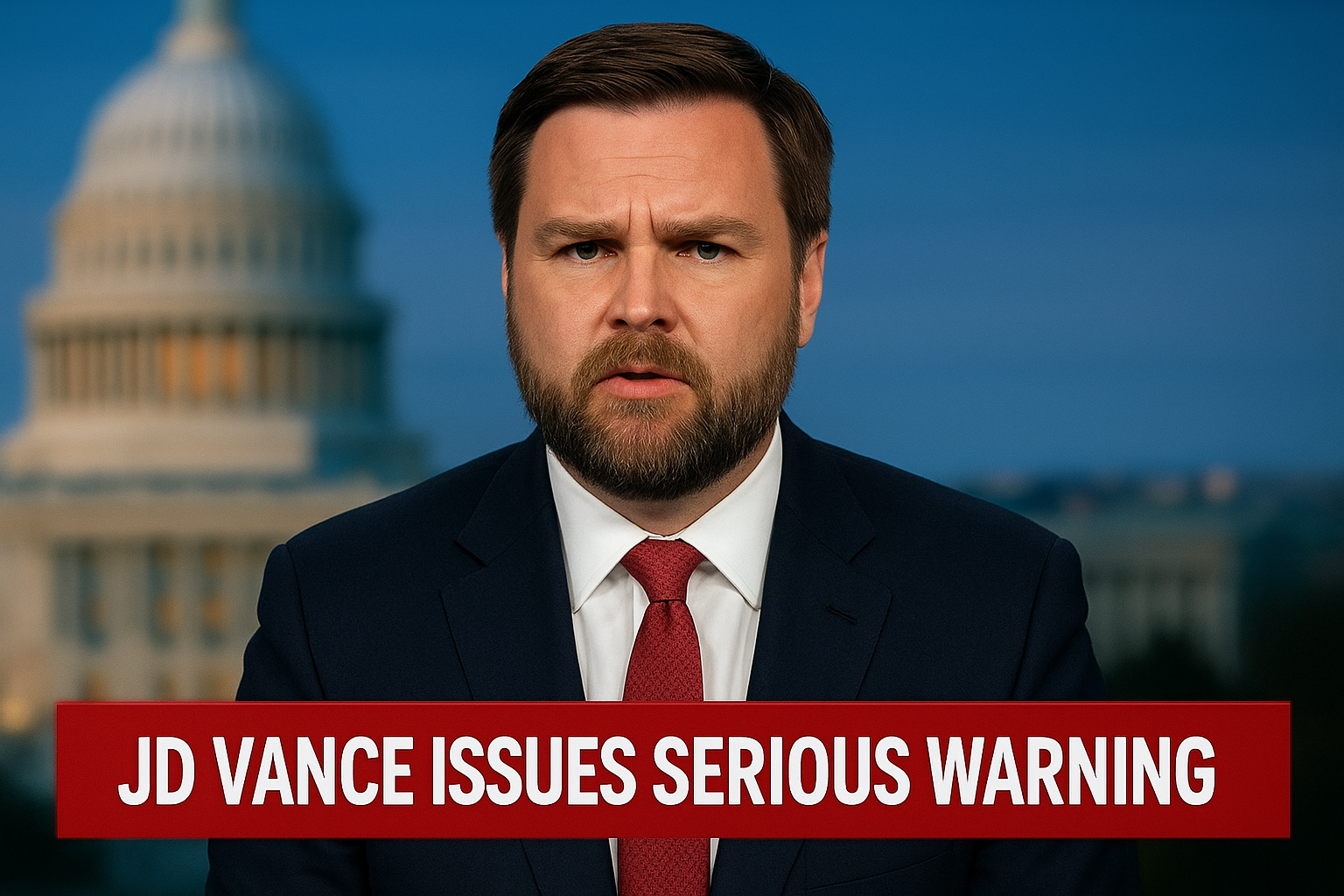
JD Vance Issues Serious Warning: Some Hamas Hostages May Never Return to Their Families
Regarding the fate of hostages taken by Hamas, U.S. Vice President JD Vance delivered a sobering and stark message on October 12, 2025: some of those killed in captivity might never be reunited with their families. The JD Vance Issues Serious Warning highlights the terrible toll that the Israel-Hamas conflict has taken on human lives and highlights the boundaries of diplomatic and rehabilitation efforts, even in the wake of a ceasefire.
The Contextualised Warning JD Vance Issues Serious Warning
The comments followed a ceasefire between Israel and Hamas mediated by the United States, which raised hopes for peace in the Middle East. That deal calls for Hamas to return the remains of 28 people thought to have died in captivity and free 20 hostages who are still alive.
Speaking on Fox News’ “Sunday Morning Futures,” Vance discussed the difficulties of both recovering the remains of the deceased and releasing captives who are still alive. “With continued efforts, we’ll be able to give them to their families so they at least have some closure,” he said, acknowledging that “some of the hostages may never get back.”
He added:
“We do wish to provide these individuals with the opportunity to be buried properly. It will continue to be a priority, but it will take time.
Vance stated his belief that the majority of the remains would eventually be returned, but he did not state that he was positive that all would be recovered.
Why it matters that JD Vance Issues Serious Warning


Emotional and Humanitarian Cost JD Vance Issues Serious Warning
- Vance’s caution highlights the extreme psychological suffering that hostage families go through. For loved ones, closure depends on the expectation of a physical reunion or, at the very least, a dignified funeral. The eerie possibility that what’s left might never come to light prolongs trauma, uncertainty, and grief.
Diplomacy and Recovery’s Limitations JD Vance Issues Serious Warning
- Recovering remains from conflict areas is difficult, both politically and logistically, even after a ceasefire. Recovery efforts may be hampered by terrain, devastation, a lack of cooperation, and the fog of war. Vance’s comments recognise these harsh facts: intention and goodwill might not be enough.
Management of Credibility and Expectations JD Vance Issues Serious Warning
- Politically speaking, Vance’s openness helps to lower expectations. He might lessen the possibility of criticism or disappointment if some remains cannot be found by establishing reasonable limits on what can be recovered. It presents the endeavours as something that is extremely difficult to accomplish rather than as something that is certain to succeed.
U.S. Intent Signalling JD Vance Issues Serious Warning
- Vance reiterated that the recovery of remains is a priority for the United States, even as JD Vance Issues Serious Warning. The declaration that “it will remain a focus” demonstrates a dedication to sustained work despite ambiguity.
The Wider Scene of Ceasefire and Hostage-Exchange after JD Vance Issues Serious Warning

The Attack and Hostages on October 7, 2023
- Hamas’ multifront attack on October 7, 2023, which resulted in casualties and the capture of hostages, marked the beginning of the conflict’s immediate escalation. Many hostages were held in Gaza during the ensuing conflict, and some are thought to have perished while in captivity.
The Hostage Return Plan & Ceasefire Agreement
- Hamas is required by the current ceasefire agreement to return the remains of the dead and free the remaining hostages.
- Israel anticipates that the 20 surviving hostages will be turned over to the International Committee of the Red Cross in one shipment before being returned to Israel.
- A global task force will also start looking for dead hostages who haven’t been returned within a 72-hour period.
Symbolic and Political Risks
- It is extremely symbolic and politically delicate to return hostages, especially those who are still alive. It is a concrete example of diplomacy, success, and humanitarian concern. Critics may also use the failure to recover all remains to cast doubt on the efficacy of Israeli operations, U.S. diplomacy, or the ceasefire.
Responses and Consequences
The Hostages’ Families
- JD Vance Issues Serious Warning may cause conflicting emotions in hostage families: relief that the effort is appreciated and fear that a loved one may never be found. Whether remains are returned and how the United States and Israel prioritise these missions will be closely watched by many families.
Public Opinion and the Israeli Government
- The ceasefire and hostage return have been presented as victories by Israel’s leadership. However, if remains are not fully recovered, the public might react negatively, particularly for hostages who are thought to be dead. By emphasising the uncertainty of recovery itself, Vance’s warning could reduce the likelihood that blame will be placed on Israeli or American authorities.
Palestinian Reaction to Hamas
- The inability of Hamas to return some remains could be interpreted as a sign that the other side is not cooperating or negotiating, or it could be used as leverage. On the other hand, if the remains are successfully returned, Hamas might feel that their involvement in the agreement has been partially validated.
Credibility & U.S. Foreign Policy
- As the guarantor and mediator, the United States has a stake in the successful return of hostages as well as the integrity of the situation. Vance’s message strikes a balance between realism and resolve, maintaining American credibility by demonstrating that the difficulties of recovery are recognised and understood.
Recovery Difficulties

There are several challenges in recovering the remains of dead hostages from areas of conflict that are currently or have recently been active:
Rubble & Destruction:
- Infrastructure, tunnels, and buildings may be destroyed, burying remains beneath difficult-to-reach debris.
Risks to Access and Security:
- Areas might still be contested, mined, booby-trapped, or controlled by the enemy.
Identification Challenges:
- Forensic identification is made more difficult by fragmentary, deteriorated, or mixed remains.
Absence of collaboration or obstruction:
- Parties may refuse access, conceal locations, or give insufficient details.
Degradation and Time Delay:
- The likelihood that something will deteriorate or be lost increases with the length of the delay.
These operational realities—that not every case will result in a body, even with the best efforts—are implicitly acknowledged in JD Vance Issues Serious Warning.
Considering the Future: What Could Occur?
Partial Recuperations
- If active cooperation is maintained, there is a good chance that many remains will eventually be recovered and identified. According to Vance’s own words, he anticipates “most” returns.
Some That Are Still Absent
- However, a subset might never be retrieved. Vance foreshadows that possibility with the phrase “some … may never get back.”
Global Surveillance & Assistance
- An international task force’s participation in recovery efforts provides some oversight, credibility, and possible objectivity.
Media and Political Criticism
- Media coverage and political narratives may cast doubt on the deal’s sufficiency, the function of US diplomacy, or the dedication of all parties if remains are not completely recovered. Some of that criticism might be absorbed by Vance’s forewarning.
Ongoing Negotiations & Efforts
- Additional remains may eventually be discovered through additional negotiations, intelligence gathering, or cooperative excavations, even after the initial exchange. Months or years may pass during the process.
JD Vance Issues Serious Warning is more than just a catchy headline; it’s a sobering admission of the difficult boundaries of diplomacy in times of conflict. The reality of broken ground, uncertainty, and operational challenges means that not every lost life can be physically recovered, even though ceasefires, hostage releases, and negotiations provide hope.
But Vance’s remarks also contain a pledge: the United States and its allies will keep working to provide bereaved families with respect and closure, not just to put an end to hostilities. That mission is important, even when tragedy strikes.