Trump’s jail threat gets met with “Come and Get Me” by JB Pritzker.
Something very bad happened when former President Donald Trump said in public that Illinois Governor JB Pritzker “should be in jail” for not protecting ICE agents. Pritzker didn’t back down; instead, he issued a bold challenge: “Come and get me.” There is a serious fight going on in the United States over federal power, state sovereignty, and political norms that looks like political theatre.
What set it off was Trump’s accusation. JB Pritzker
Trump wrote on his social media site, Truth Social, on October 8, 2025, “Chicago Mayor should be in jail for failing to protect Ice Officers! And Governor Pritzker too!” It was said that Pritzker and Chicago Mayor Brandon Johnson failed to protect federal agents while ICE operations were going on in the city.
Trump’s call wasn’t just empty words. At the same time, he had sent National Guard troops to Illinois to help with what his administration called “enforcement efforts” related to immigration operations in Chicago.
Trump even hinted that he might use the Insurrection Act of 1807, a federal law that lets the president send military forces to the United States to help with problems in the country if local or state officials get in the way of his plans.
Critics say this turns the argument into a fight over the Constitution’s limits, especially when it comes to the federal government’s power over cities and states.
JB Pritzker’s Answer: Defiance Over Retreat
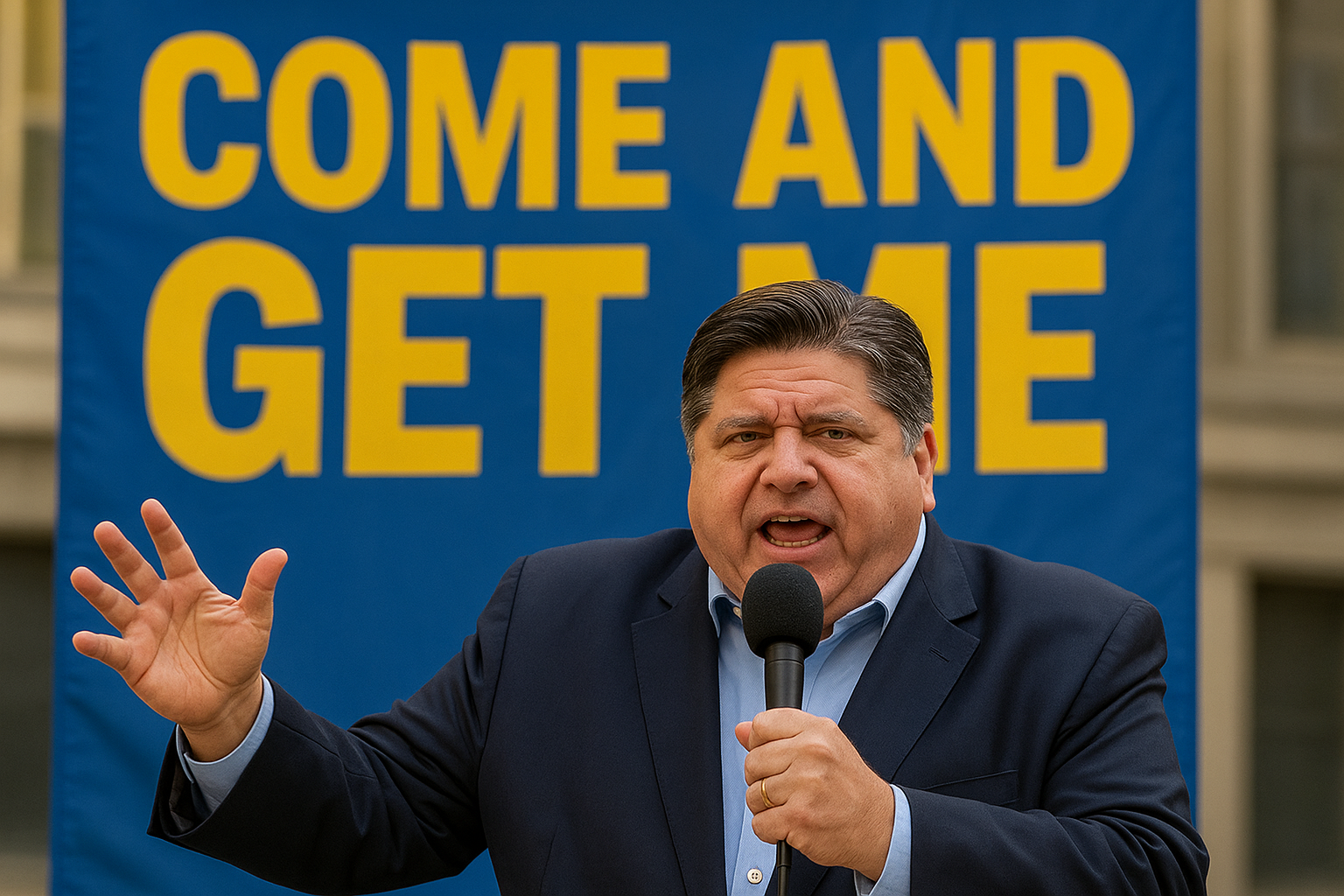
It was clear what Governor JB Pritzker meant. He pushed back straight away at a rally for federal workers in downtown Chicago, saying, “Come get me.” He called Trump a “coward,” said he was “deranged,” and said he wanted to be in charge. “What kind of country do we live in if the president goes after people who disagree with him?” These are people who are against him even though they haven’t done anything wrong.
Pritzker also said that the threats were part of a bigger plan to get people to accept the presence of military in cities, possibly to change the results of upcoming elections. He thought that the main goal was to scare people and mess up the 2026 midterm elections.
Just like always, Pritzker saw Trump’s comments not just as an attack on him personally, but also as a test of democratic norms and power limits.


Operation Midway Blitz and Guard Deployment: A More General View
To see why this fight has made things worse, you have to take a step back and look at the bigger picture of federal immigration campaigns and local resistance.
ICE started Operation Midway Blitz in Chicago in early 2025 as a crackdown on undocumented immigrants, especially those who had criminal records. The operation drew strong objections from local and state officials, in part for its lack of consultation and its disruptive impact on immigrant communities.
Illinois and Chicago leaders have argued that many of the targeted individuals were integrated, law-abiding residents. Pritzker has said his administration supports deporting convicted criminals but opposes casting a wide net over law-abiding immigrants.
Pritzker’s office and many local officials were offended when Trump ordered the deployment of National Guard troops, some from Texas and some from Illinois, to Chicago in order to “help protect ICE facilities.”
Citing constitutional limitations on military intervention in domestic matters (the Posse Comitatus Act) and state sovereignty, Pritzker blasted the deployment as a “invasion” and filed a lawsuit to stop it.
Instead of blocking the deployment right away, a federal judge decided to hold a hearing. However, if Trump attempts to escalate further, Pritzker and his legal team have warned that more will follow.

The Significance of JB Pritzker in This Conflict
Although personalities are responsible for some of the drama, JB Pritzker is more than just the object of Trump’s wrath. Several important themes are highlighted by his role and his response:
1. State versus Federal Power
- Pritzker is defending the idea that states and governors have a say in how federal operations are carried out within their borders by opposing Trump’s troop deployment and calls for his arrest. The clash foregrounds legal and constitutional limits on executive power.
2. Ambitions for the Nation and Political Branding
- Pritzker is a well-known Democratic governor who may become more well-known nationwide as a result of his defiant stance. He may run for higher office, according to some observers. His political positioning is demonstrated by his determination to maintain his position in such a crucial conflict.
3. Supporting Civil Rights and Immigrant Rights
- Pritzker’s opposition to broad immigration crackdowns is consistent with his standing as an immigrant rights advocate. He has continuously maintained that enforcement should concentrate on threats to public safety rather than generalisations. He portrays Trump’s strategies in this battle as assaults on underprivileged groups.
4. Protecting Norms and Democracy
- Pritzker is asserting not only his own power but also the maintenance of democratic checks and balances by reacting boldly rather than in silence. According to his rhetoric, the foundations of democratic governance are undermined when one complies with a president’s threats.
Possible Dangers and Risks
- Pritzker’s decision is not without risk, of course. He may be subject to severe legal, political, or reputational consequences if the legal system or political winds turn against him.
- Legal Exposure: Although Pritzker does not appear to be the subject of a criminal case, Trump is making extralegal threats that could expose Pritzker to legal scrutiny should federal authorities conduct an investigation.
- Political Backlash: Presenting the battle in such a combative manner could turn off moderate voters or incite detractors who think his tone is excessively harsh.
- Escalation: Trump’s toolkit consists of public statements, legal strategies, and executive authority. The conflict might turn into a constitutional crisis if he goes on to use the Insurrection Act or other contentious tactics.
- Broader executive power norms: The conflict could establish precedents for the president’s discretion in targeting state officials.
Last Remark
Few events in politics garner as much attention as a daring public dispute. Not only was JB Pritzker denying an accusation when he looked into the camera and said, “Come and get me,” but he was also asserting his constitutional authority, the dignity of dissent, and the principle that no elected official should submit to threats.
This conflict will reverberate outside of Illinois, regardless of whether it results in court rulings, political repercussions, or increased polarisation. For the time being, Pritzker has established a boundary and demonstrated his determination to uphold it.