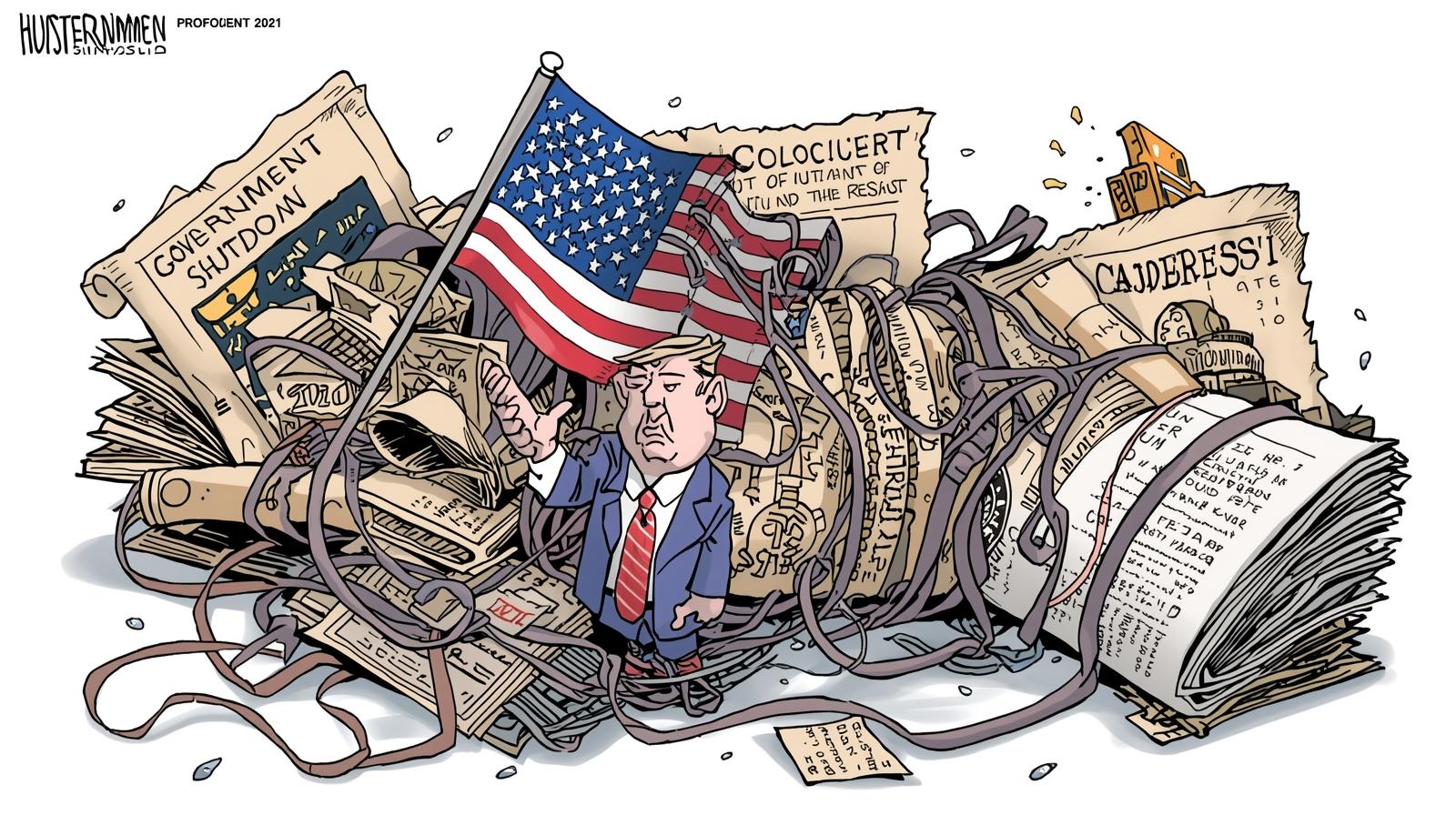
Government Shutdown 2025: An Imminent Crisis in American Governance
The United States is once again on the verge of a government shutdown 2025, which could stop major parts of government operations due to a potentially disruptive lapse in federal funding, as September 30, 2025, draws near. This year, the ongoing budget appropriations standoff has become more intense, with agency cuts and health care policy disputes raising the possibility of a protracted shutdown.
This article examines the implications of a government shutdown in 2025, its causes, its potential severity, and what to look out for in the days ahead.
What Constitutes a Government Shutdown 2025 and Why 2025 Seems Different
When Congress does not pass appropriations or a continuing resolution (CR) to finance federal agencies and operations, the Government Shutdown 2025 . Non-essential federal employees are placed on furlough until funding is restored, and many government operations must halt due to a lack of legal authority to spend. Usually, essential services (like public safety or national security) continue, albeit with limitations.
The fallout from previous shutdowns was frequently minimal, and government operations resumed as soon as Congress approved emergency funding. However, the Government Shutdown 2025 has a number of escalating factors:


- In programs judged to be out of line with the administration’s priorities, the White House is directing agencies to schedule mass, permanent layoffs—not just temporary furloughs.
- A broad hiring freeze for federal civilian positions has already been put into place by the Trump administration and has been repeatedly extended until October 15, 2025.
- Many federal employees had the option of a buyout-style exit through a contentious “deferred resignation” program earlier this year; more than 154,000 accepted full pay through September 30 while essentially leaving their positions vacant.
- Finding a compromise is more challenging this time around because the budget battle is intricately linked to health care policy (such as the extension of Affordable Care Act subsidies and the reversal of Medicaid cuts).
The stakes are raised because a Government Shutdown might cause more serious institutional harm and make recovery more difficult.
Why Have We Come Here? The Political and Policy Deadlock
- To finance all federal programs, Congress is expected to approve twelve appropriations bills annually. However, many of those bills are still unfinished in 2025. Congress now uses stopgap measures, or continuing resolutions, to keep spending at previous levels in order to prevent a complete Government Shutdown.
- Republicans, who control both the House and the Senate, have put forth a CR that would extend funding until November 21 primarily at 2025 levels with few changes.
- However, Democrats will not back a clean CR unless it includes measures to extend health insurance subsidies (under the ACA) or reverse Medicaid cuts. They contend that the agreement must include these statutory health protections.
- Political positioning ahead of upcoming elections makes each party reluctant to appear weak, which exacerbates the standoff.
- Many believe that the Trump administration’s threat to use impoundment powers—which involve withholding funds—is unconstitutional because it deviates from congressional directives.
- Additionally, internal memos tell agencies to get ready for force reductions, indicating that the administration might try to restructure federal operations in the event of a shutdown.
- By March 2025, there were 2.2 million workers, down from roughly 2.3 million in late 2024.
- In anticipation of budget cuts, agencies have already provided early retirements or voluntary separation packages.
- There were gaps in institutional memory and continuity as a result of the deferred resignation program, which further eliminated positions while keeping payroll through September.
What Would Happen in the Event of a Government Shutdown 2025?

- Federal employees who are not essential may be placed on unpaid furlough, numbering in the hundreds of thousands. Until Congress restores funding, even “essential” workers (such as law enforcement, TSA, and air traffic controllers) may continue to work without compensation.
- Federally funded contractors may experience sudden stop orders that leave them in limbo or without payment.
- Career government employment may become even more unstable as a result of the administration’s plans for permanent cuts, which may result in the loss of some jobs.
- Air traffic controller hiring and training would come to a standstill, exacerbating the shortage and increasing the possibility of aviation bottlenecks.
- Permit approvals, grant processing, and research funding are examples of internal services that might pause.
- Customer service, such as managing Social Security records or administrative duties for Medicare or Medicaid, may lag or stop.
- There could be a reduction in regulatory oversight or inspections by organisations such as the FDA, OSHA, or the Environmental Protection Agency.
- During shutdowns, public buildings, museums, and national parks frequently close, which has an impact on local economies and tourism.
- Some analysts estimate that every week of shutdown costs the economy $7 billion in lost economic output.
- In an uncertain environment, business and consumer confidence may decline, which could be reflected in postponed investments.
- Small businesses that rely on government contracts and supplier industries are affected by federal procurement.
- Policy decisions may become more difficult if important economic data releases—like the October jobs report—are postponed or compromised.
- Voters may hold Republicans accountable if they disrupt vital services, even though they control Congress and the White House.
- Democrats will claim that they remained steadfast in their commitment to safeguarding vulnerable groups and health care.
- Federal workers and unions may react negatively to the administration’s audacious plan of mass layoffs.
- Longer-term institutional harm could erode public confidence in the ability of the government.
What Could Make or Break a Government Shutdown 2025 ?

- To keep the government running while talks go on, Congress could pass a CR (for example, extending funding until November 21). This option is being promoted by Republicans.
- Democrats might insist on Medicaid restorations and health care protections. These could be combined with funding extensions in a compromise.
- Although legal and constitutional constraints make it more difficult, the administration may try unilateral measures (such as executive orders or impoundment) to selectively target programs.
One side may give in to prevent more extensive harm if pressure increases (from the public, media, states, and interest groups). - As a final attempt to prevent shutdown, President Trump and congressional leaders are currently scheduled to meet in a high-stakes meeting.
Things to Watch Over the Next Few Days for Government Shutdown 2025
- Will a CR passed by the House be taken up by the Senate, or will it be amended to include provisions pertaining to health care?
- Is it possible for at least seven Senate Democrats to vote in favour of a continuation bill?
- Will the White House abandon its plan to implement widespread, long-term layoffs?
- How do impacted federal workers react—through political mobilisation, union actions, or protests?
- What would happen to the economy and markets if uncertainty increased?
- Will a last-minute agreement be reached before September 30 at midnight?
The threat of a Government Shutdown 2025 highlights a destructive and recurrent trend in American budget politics. However, it feels different this time. A Government Shutdown 2025 is more risky and more difficult to recover from than in previous years due to a combination of executive aggression, workforce eroding, and high-stakes policy demands, especially in the healthcare sector.
If a Government Shutdown 2025 does start, the longer it lasts, the more it costs the federal workforce, public services, the economy, and the reputation of American leadership. However, there is still opportunity for last-minute compromise because of the high stakes.