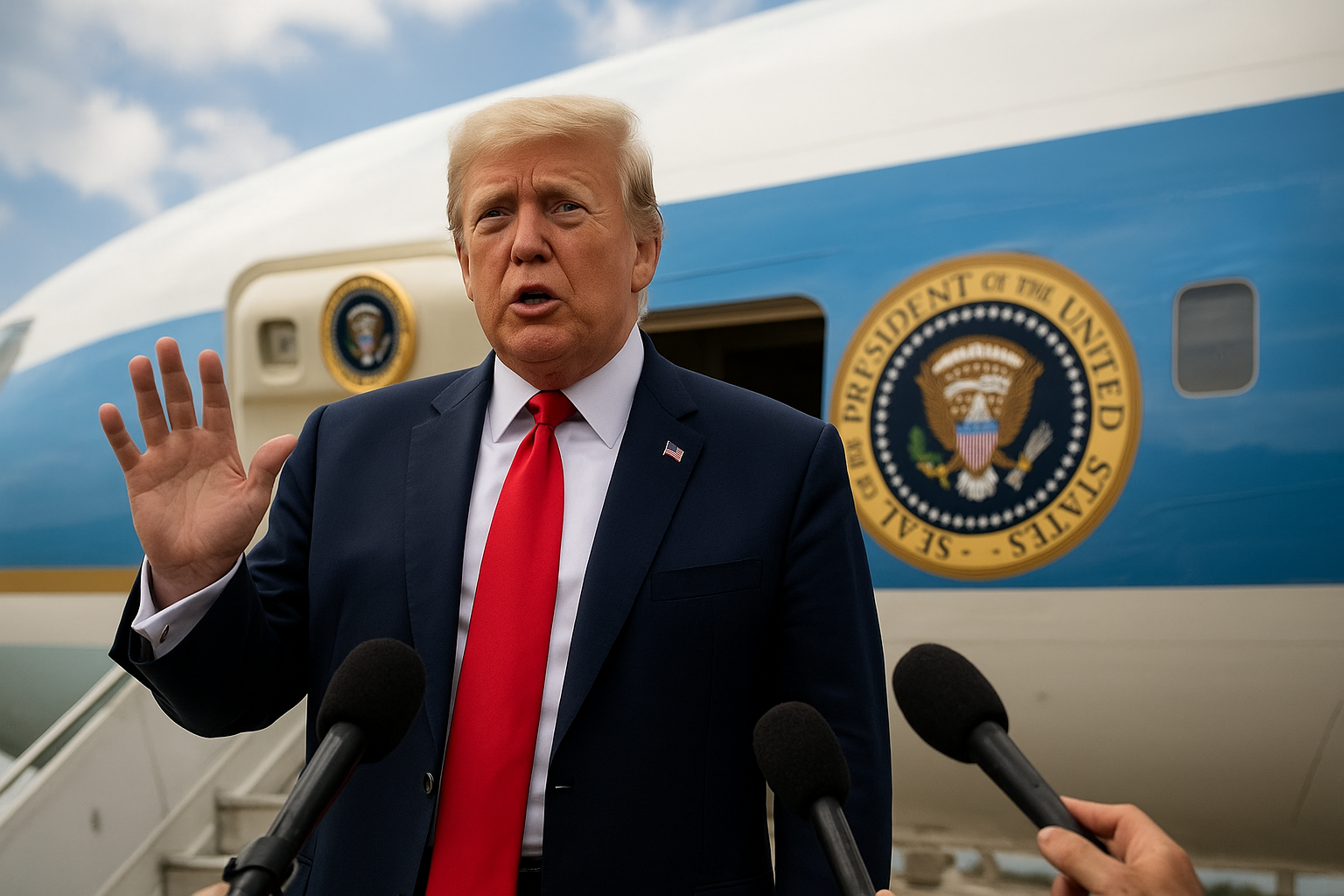
The Gaza war is over : Trump Leaves for Israel While Hostages Are Being Prepared to Return
As he left for Israel to mark what may be a turning point in the Middle East peace process, U.S. President Donald Trump abruptly declared that the Gaza war is over. The announcement coincides with plans to free Palestinian prisoners under a recently mediated ceasefire and return Israeli hostages held by Hamas. The world closely observes as the wounds of war, decades of hostility, and a tenuous truce come together for a hopeful but uncertain moment of reconciliation.
The Gaza war is over.
“The war is over, you understand that,” President Trump told reporters on board Air Force One as it took off from the United States. In response to a question about whether the ceasefire would last, he continued, “I think it’s going to hold.” I believe that people are sick of it. The U.S. administration’s close participation in recent negotiations and its aspirations for a shift from an active conflict to diplomatic normalisation were emphasised by his firm tone.
One of the most obvious indications to date that the Trump-brokered agreement might have been successful in stopping Israel-Hamas violence was this public declaration. Before his departure, the ceasefire had already been in effect for several days with no significant violations noted.
However, it is important to consider the context of the assertion that the war is over. Although there seems to be a lull in active combat, there are still many unresolved issues, particularly in Gaza, where there are still concerns about accountability, security, reconstruction, and governance.
The Gaza war is over under Trump’s Mission


President Trump’s visit to Israel is being hailed as a political climax to a diplomatic breakthrough, so it’s more than just symbolic. After meeting with the families of the hostages and speaking to the Israeli Knesset, he is anticipated to go to Egypt to co-chair a regional peace summit. The goal is both celebratory and performative, demonstrating the United States’ determination to lead the world’s transition from war to stabilisation.
Trump’s involvement has been praised by Israeli leaders. Israeli President Isaac Herzog declared that Trump would be awarded the Israeli Presidential Medal of Honour after the last hostages were freed. Trump is anticipated to make a speech in the Knesset that frames this as the beginning of a new era in the Middle East.
However, despite these well-publicized actions, the situation on the ground is still unstable. The success of any long-term peace is precarious due to deep mistrust, extremely narrow margins for error, and the political divisions in Israel and Palestine.
The Return of the Hostage and the Exchange of Prisoners after Gaza war is over
The return of Israeli hostages held by Hamas and Israel’s reciprocal release of prisoners are arguably the deal’s most emotionally charged components. All 20 Israeli hostages who were still alive were freed and placed under Israeli custody in accordance with the ceasefire agreement. Israeli military personnel and the Red Cross handled these returns.
At the same time, Israel started freeing over 1,900 Palestinian prisoners, including those who had been held since the start of the conflict. In the midst of both tension and joy, many of these liberated people arrived in the West Bank and Gaza Strip.
But not everything was settled right away. The agreement also stipulated that within 72 hours of the military withdrawal from Gaza, the remains of the hostages who had died must be returned, and any unresolved matters (like the release of more bodies) must be resolved. Beyond that window, some remains might still be denied or postponed, causing distress for families and possibly causing diplomatic problems.
Operation Shavim Legvulam, or “Returning to their border,” is the overarching operation that oversees the exchange and presents the hostage returns as both humanitarian and symbolic.
The hostages’ families have travelled to see their loved ones return. The public ceremonies, medical examinations, and tearful reunions are meant to highlight the war’s human cost and the intense desire for closure.
The Reconstruction, Withdrawal, and Ceasefire The Gaza war is over.

Phased withdrawals, humanitarian corridors, and diplomatic oversight usher in the end of active hostilities, which is not just a pause. Israeli forces retreated to predetermined lines from many areas of Gaza in accordance with the terms of the agreement, and a joint control centre led by the United States was set up to oversee adherence.
The ceasefire came into force after the withdrawal was finished. According to the agreement, the remains of hostages who have died must be returned within 72 hours of their withdrawal, as must all hostages who are still alive. Under Israeli and American supervision, aid access to Gaza is also to be greatly expanded, with hundreds of trucks anticipated each day.
A 20-point peace plan is to be put into effect in the long run. Proposals for an International Stabilisation Force (ISF) to assist with security, train new Gaza police, supervise demilitarisation, and oversee transitional periods are included in this. In order to provide temporary governance for Gaza while a Palestinian authority undergoes reform, the Gaza International Transitional Authority (GITA) has also been proposed.
Even with the optimism, challenges remain. There is still much disagreement over Hamas’s future role, whether it will disarm or dismantle its military wing, Gaza’s final political status, and how governance will operate under international supervision. Given the potential for ongoing security threats, some Israeli hardliners have voiced doubts about agreeing to these terms.
Risks and Reactions after the Gaza war is over
Numerous world leaders praised the ceasefire and underlined the significance of establishing a lasting peace. Trump was praised as a peacemaker in Jewish and Israeli circles, and some even suggested he should receive the Nobel Peace Prize.
However, detractors warn that Trump’s assurance might be too soon. The claim that “the war is over” is disputed; defence officials are still leery of a resumption of fighting, and Israeli Prime Minister Benjamin Netanyahu reportedly insists that military operations are not entirely over.
The right-wing coalition may oppose concessions related to oversight and prisoner releases in Israel’s unstable political environment. The humanitarian situation in Gaza is dire: famine is imminent, medical systems are overburdened, infrastructure is destroyed, and many people are homeless. There is a severe lack of trust because any transgression, whether by Israel, Hamas, or other parties, could spark violence again.
More than two dozen hostages are thought to have perished in captivity, and the returns of all remains are still pending, even though 20 living hostages were freed. Delays in some remains could cause political unrest and psychological harm.
Enforcement is a persistent question: who makes sure that everyone abides by the terms? There is little space for enforcement by the recently established joint centres and international monitors. The tenuous peace could be ruined by any perceived breach or rumours of one.
Next Steps—Watch Points after Gaza war is over


A number of significant events will indicate whether this moment turns into a permanent peace or a precarious ceasefire as Trump travels to Israel and Egypt:
1. Integrity of Implementation after Gaza war is over :
- Will both parties fulfil their commitments (withdrawal, exchange of prisoners, humanitarian access, and release of hostages or remains)? Even minor infractions have the potential to destroy trust.
2. The function of global oversight after Gaza war is over :
- The efficiency of the monitors, transitional bodies, ISF, and joint control centre will be crucial. They must be seen as credible in their enforcement, authority, and impartiality.
3. Reconstruction after Gaza war is over :
- The social and physical infrastructure of Gaza needs to be completely rebuilt. Resources and political will will be put to the test as livelihoods, healthcare, education, sanitation, and housing are rebuilt.
4. Gaza’s security after Gaza war is over :
- Israel’s security calculation depends on ensuring that Hamas’s military capability is eliminated or properly controlled. One of the main concerns will continue to be whether Hamas disarms or how to handle its remaining forces.
5. Legitimacy and Political Integration after Gaza war is over :
- Long-term stability in Gaza will depend on the governance model, which includes the role of civil society, the evolution of representation, and the extent of power held by the Palestinian Authority (or an interim body).
6. Local Dynamics after Gaza war is over :
- Global powers like the United States, the European Union, and Russia, as well as neighbouring states like Saudi Arabia, Qatar, Egypt, and Jordan, will continue to shape the future. The desire for pressure, diplomacy, and investment will be important.
7. Memory & Narratives after Gaza war is over :
- Reconciliation will be influenced by how Israelis, Palestinians, refugees, and the families of the victims remember the conflict. Stories of justice, accountability, and acknowledgement of suffering are all very important.
An Uncertain Future Despite a Historic Moment after Gaza war is over
More than just a headline, “Gaza war is over : Trump sets off for Israel amid preparations for hostages’ return” marks a symbolic turning point in a decades-long conflict. The images are striking: a U.S. president overseeing what many believe to be a watershed moment, hostages being released, and war being declared over.
But there are many obstacles in the way. Peace requires justice, security, trust, and workable daily governance because war scars are deep and peace is more than just the absence of bombs. The tenuous truce may break down if any one of the elements fails.
Following through, exercising restraint, and having political courage will determine whether this moment turns into a long-lasting breakthrough or a brief lull. But for now, the world observes as hostages return, Trump enters Israel, and Gaza finds itself at a turning point.