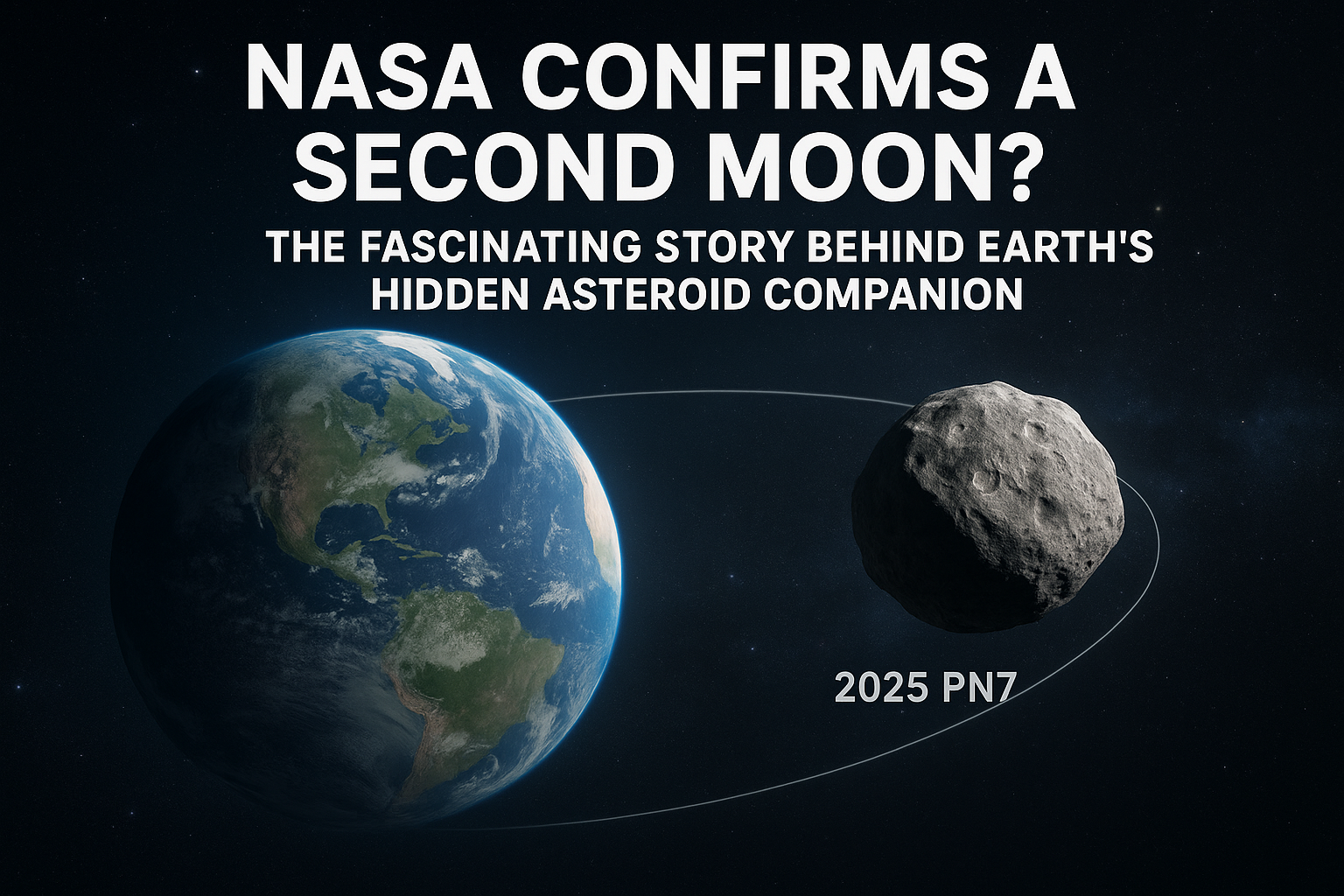
What took place? after nasa confirm earth two moons
A tiny celestial object known as 2025 PN7 was found by astronomers earlier in 2025. The object appears to have been quietly co-orbiting with Earth for decades, despite only being discovered this year (official discovery date: August 2, 2025 at the Pan-STARRS Observatory in Hawaii).
- Unlike our regular moon, which is permanently affixed to Earth, 2025 PN7 is not a true moon.
- Rather, it is a quasi-satellite, also known as a “quasi-moon,” which is an object that moves in a 1:1 resonance with the Sun, appears to follow Earth, and is not gravitationally attached to us.
- According to estimates, it has been travelling with Earth in this manner for about 60 years, and it might continue to do so until 2083.
- In comparison to our Moon, which is approximately 3,474 km across, 2025 PN7 is expected to be only 18–36 meters wide.
It’s true that Earth has a second “partner” in space, but it’s not a full moon that will take over the sky.


The Reasons Behind “Earth Two Moons” in the Media
“Earth Two moons” is a great headline phrase. Concern, awe, and conjecture were aroused by the discovery of 2025 PN7; numerous news outlets noted that we would have this peculiar companion for the ensuing decades. An article in The Economic Times, for instance, stated:
- “A quasi-moon that has been circling close to Earth for about 60 years has been identified by astronomers as 2025 PN7.”
However, the majority of reliable sources make it clear that this is not a true moon in the sense that it is not attached to Earth by gravity. Instead of circling the Earth directly, it follows our orbital “track” around the Sun.
How Does It Circulate? Quasi-Moon: What Is It? Earth two moons
A moon typically circles its planet because the planet’s gravity holds it in place. However, a 2025 PN7 quasi-moon is distinct:
- About the same speed as Earth, it revolves around the Sun.
- From Earth’s perspective, it appears to be a companion because it maintains a 1:1 orbital resonance with the planet.
- It can eventually drift away and is not bound by Earth’s gravity.
- Though uncommon, such objects are not new; Earth has previously had companions of a similar nature.


Is It Risky? Might It Turn Into a Large Moon? Earth two moons
In a nutshell: There is no risk or possibility of a second full moon.
- The object has no discernible impact on Earth’s orbit, climate, or tides. In contrast, its mass is minuscule.
- It doesn’t come close enough to Earth to be a threat for impact, so it’s comparatively far away.
- It is susceptible to perturbations (gravitational influences) that will ultimately push it away because it is not bound. It is expected to depart sometime in 2083.
Why Science Cares About Earth Two Moons
- It provides information about the long-term behaviour of near-Earth objects (NEOs) entering Earth-sharing orbits.
- We can better comprehend orbital resonances and the dynamical environment surrounding Earth’s orbit by studying such objects.
- Additionally, it may offer hints about the origins of some asteroids, their evolution, and what may eventually be reachable by future missions.
- These kinds of discoveries challenge our observational boundaries; the ability to detect such a small, faint object that had gone unnoticed for decades demonstrates advancements in survey capabilities.


The Bigger Picture: There are earth two moons and a busy earth in the neighbourhood.
Small bodies like comets and asteroids constantly move, change, and sometimes transform into planets’ meta-companions, demonstrating how dynamic our solar system is. Actually:
- In late 2024, Earth caught a “mini-moon” event called 2024 Pt5, which orbited briefly before vanishing.
- It is known that some asteroids, like 469219 Kamo‘oalewa, have enduring quasi-satellite connections to Earth.
Therefore, a more accurate story would be: Earth has one true moon, and sometimes minor objects share its orbital lane for a while. This is more accurate than “earth one moon vs. earth two moons.”