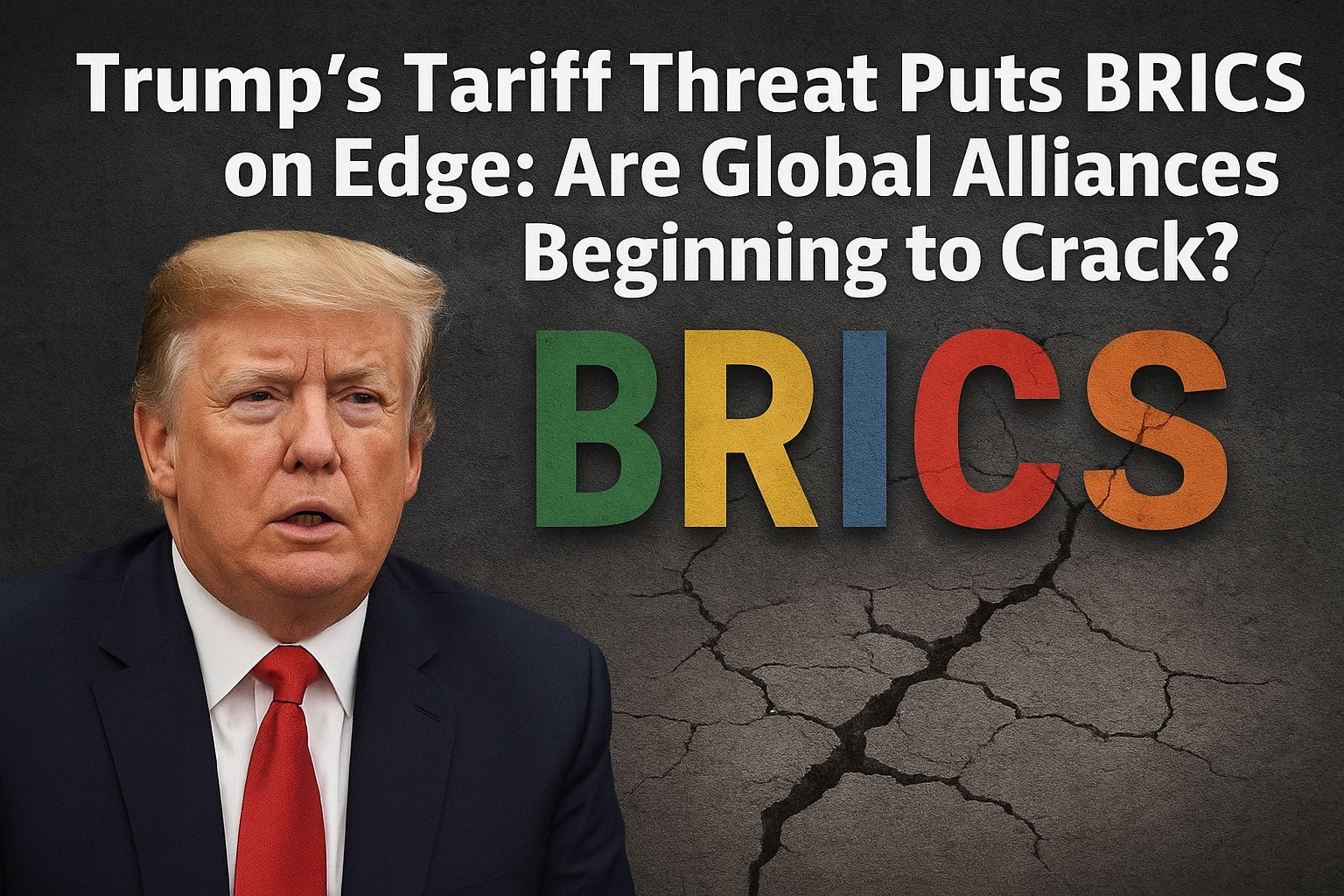
“Every country is leaving BRICS,” Trump says, threatening new members with US tariffs.


U.S. President Donald Trump has boldly escalated his trade rhetoric by threatening to impose additional trade penalties on any nation that joins or stays a member of BRICS (Brazil, Russia, India, China, South Africa, and newer members). Additionally, he asserted that “all nations are dropping out of BRICS,” suggesting that his warnings have already caused defections.
The message was given in a combination of political posturing, economic strategy, and claims of U.S. financial dominance during a bilateral meeting with President Javier Milei of Argentina at the White House. Trump stated, “I told anybody who wants to be in BRICS, that’s fine, but we’re going to put tariffs on your nation.” “Everyone left. All of them are leaving BRICS. The dollar was attacked by BRICS. All of your goods entering the United States will be subject to tariffs from me.
However, the claims are closely examined beneath the dramatic tone. Are countries truly leaving BRICS? What geopolitical or legal restrictions underlie Trump’s threat? And how might the dynamics of international trade be altered by this rhetoric?
The Main Allegation: A Threat of Tariffs Against BRICS Partners

Trump’s rhetoric: supporting the dollar
- The U.S. dollar’s position as the world’s reserve currency is being directly threatened by BRICS, according to Trump. He implies that BRICS are attempting “de-dollarization,” or moving away from dollar-based trade and financial settlement, by referring to them as “an attack on the dollar.” He believes that justifies retaliatory tariffs.
- He draws a “line in the sand” to prevent the growth of alternative payment and trade methods that could circumvent the financial reach of the United States. He told potential BRICS members that while they could join, they would be penalised for exporting to the United States.
The assertion that “they’re dropping out”
- Trump claimed that nations have already given up on the BRICS goals as a result of his threats: “Everyone left. All of them are leaving BRICS.
- However, this claim has been seriously questioned by a number of analysts and expert voices. There is no solid proof that any nation has officially left the BRICS alliance. Instead, BRICS is expanding by consolidating its membership and granting “partner” status to more nations.
- According to geopolitical analysts, Trump’s assertion is probably a rhetorical exaggeration that reflects strength rather than reality.
The Economic and Geopolitical Risks


One must view this threat as a component of a larger struggle for sovereignty, trade, and finance in order to appreciate its importance.
The conflict surrounding de-dollarization
- Many BRICS and Global South proponents have long advocated for less reliance on the US dollar in trade and reserves, sometimes through bilateral trade in local currencies or a BRICS common currency. American policymakers, who see dollar dominance as a key component of American geopolitical leverage, are alarmed by these proposals.
- Therefore, it is possible to view Trump’s tariff threat as a coercive obstacle to any deterioration of dollar hegemony. The cost of de-dollarization increases significantly if nations are aware that doing otherwise will result in punitive actions.
The U.S. tariff toolkit
- Trump has a history of employing tariffs as a foreign policy instrument. He has already implemented universal baseline duties, broad “reciprocal” tariffs, and targeted sanctions during his second term in office. One of these measures is a 25% tariff on goods originating from any nation that imports Venezuelan oil.
- He is now applying that reasoning to geopolitical alignment by threatening tariffs on BRICS members or prospective members. Nations that oppose the dollar system may face penalties.
The possibility of a trade war and reprisals
- Such a strategy encourages reprisals. Counter-tariffs, trade diversions, or additional integration with non-U.S. systems could be the response of BRICS countries or newly threatened nations. China has already indicated that it will “stand firm” against Trump’s more general tariff threats.
- Furthermore, placing tariffs on a number of major economies (China, India, Brazil, etc.) could harm American companies that rely on international supply chains, increase American consumer prices, and disrupt international trade.
Responses, Difficulties, and Inconsistencies

Expert opposition
- Trump’s claim that countries are leaving BRICS has been quickly questioned by analysts. According to Dr. Raj Kumar Sharma (NatStrat), Trump’s claims are overblown, and BRICS is actually becoming more powerful.
- Another expert on Eurasian policy noted that rather than retreating from regional and multilateral financial cooperation, nations are strengthening it as a hedge against unpredictable U.S. policy.
There are no actual exits on the ground.
- Despite Trump’s assertion, media reports state that “no country has dropped out of BRICS.” With the addition of Egypt, Ethiopia, the United Arab Emirates, and Iran as full members in 2024 and Indonesia in 2025, the BRICS membership has been expanding.
- Therefore, it seems more rhetorical than factual to claim mass defections.
India’s delicate balancing act
- For example, India, a founding member of BRICS, has made it clear time and time again that it has no plans to aggressively de-dollarize or undermine the US dollar. According to India’s foreign minister, the dollar is still essential to world stability.
- As a result, India might take a cautious approach, staying in BRICS for alliances but avoiding conflict over currencies.
Institutional and legal limitations
- If Trump’s threat is carried out, it may encounter institutional and legal opposition from the World Trade Organisation (WTO), trade associations, or the US Congress. It may be argued that trade retaliation that singles out entire nations for political alignment is discriminatory or violates trade agreements.
- The Trade Review Act of 2025, which would require that tariffs remain in force only with legislative approval after 60 days, is one example of how Congress is already considering increased oversight over unilateral trade actions.
What Could Take Place Next?

1. Deterrence and bluster
- Trump’s rhetoric may be primarily intended as bluff, a tactic to discourage the growth of non-dollar systems without imposing widespread tariffs. The threat alone may shape behavior.
2. Specific penalties
- Instead of imposing tariffs on all nations, Trump might target specific nations that are thought to pose the greatest threat, such as those promoting currency substitutes or strategic adversaries. A widespread tariff war would be too complicated and expensive.
3. Escalation and retaliation
- BRICS or its member states may respond with tariffs, restrictions on investment, or a closer alignment with competing blocs or currencies if the U.S. follows through. This might result in supply chain division, trade fragmentation, and a more divisive financial environment.
4. Pushback from institutions
- Unilateral tariff actions may be restrained or moderated by Congress, US courts, and trade organisations. Furthermore, universal penalties linked to geopolitical alignment may be contested by citing international norms (such as WTO regulations).
5. Other integration axes
- Threatened nations may step up their collaboration outside of the dollar zone, such as through local currency settlements, currency swaps, regional payment systems, and alternative financial infrastructures. Trump’s coercion may spark the very movement against the dollar that he says he opposes, if such actions continue to spread.