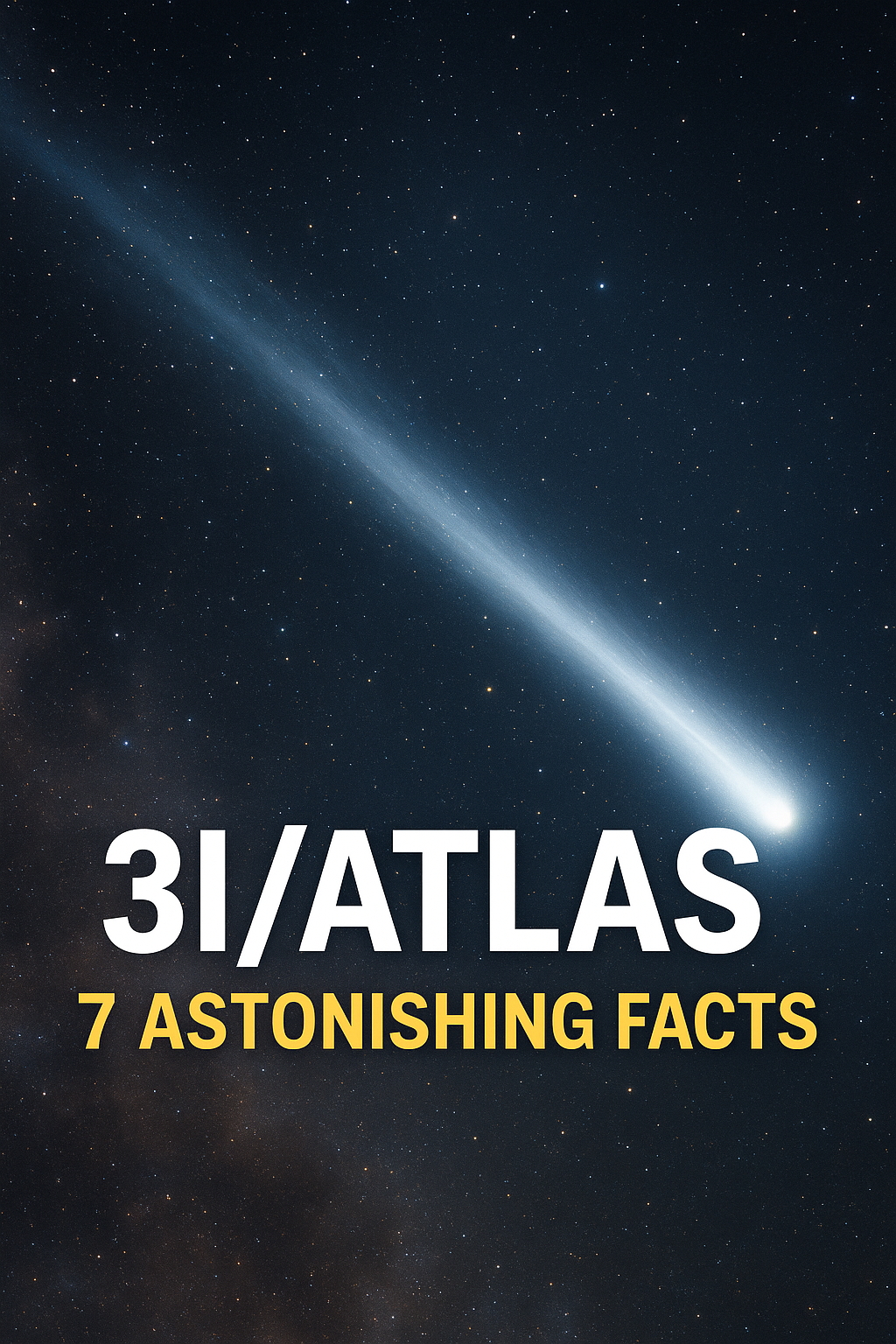
“Galactic Time-Capsule”: 3I/ATLAS’s Story
It makes headlines when the sky produces a visitor from beyond our solar system. The third confirmed interstellar object ever discovered, 3I/ATLAS, is causing quite a stir and for good reason.
An Intruder from Outside 3I/ATLAS
The Asteroid Terrestrial-impact Last Alert System (ATLAS) survey telescope in Chile made the first observation of the object, now known as 3I/ATLAS, on July 1, 2025. Astronomers soon came to the conclusion that this was not a native of our solar system based on its abnormally fast, hyperbolic trajectory. Actually, after 1I/ʻOumuamua in 2017 and 2I/Borisov in 2019, it is only the third interstellar object that we have consistently observed.
The Significance of the Name 3I/ATLAS
The abbreviation “3I/ATLAS” stands for the third interstellar object, “I” for interstellar, and “ATLAS” for acknowledging the discovering survey.


What We Currently Know 3I/ATLAS
- Orbit and speed: At about 60 km/s (130,000 mph), the object is speeding through the solar system at a rate that is significantly faster than that of comets in the solar system.
- Orbit: It follows an exaggerated path. This implies that it will pass through our area, affected by the gravity of the Sun, and then leave — never to circle the Sun in a permanent orbit.
- Age and size: Although the exact size is still unknown, some preliminary estimates point to a nucleus that could be several kilometres across. Even more intriguing is the fact that scientists believe it may be three billion years older than our solar system.
Why 3I/ATLAS Is So Interesting
- Alien Material: Its ice, dust, and chemical makeup contain hints about planet formation outside of our system because it formed around a different star.
- Possibly the Oldest Comet: 3I/ATLAS may be the oldest comet ever observed if the age estimates are correct.
- Magnificent Visibility: Its compact coma and complex tail features have been imaged by observatories like the International Gemini Observatory (Gemini North) in Hawaiʻi.
- Mysterious Tail Chemistry and Behaviour: Its spectrum displays surprising chemical signatures, such as a comparatively high CO₂/cyanogen content, and some observations indicate that its tail material is travelling in strange directions, even in the direction of the Sun.


Timetable & Recommended Content 3I/ATLAS
- ATLAS made the discovery on July 1, 2025.
- Late October 2025 will be the closest approach to the Sun (perihelion).
- Visibility from Earth: Prior to solar conjunction, ground-based telescopes should continue to observe it until early September 2025. Later in the year, when it breaks out of the Sun’s glare, observations will resume.
The Significance of 3I/ATLAS for Science (and Us)
- Galactic Relationships: Astronomers intend to examine 3I/ATLAS in order to compare its composition to comets in our own system. We can learn about the formation and evolution of star systems elsewhere by comparing and contrasting them.
- Uncommon Chance: There are few interstellar visitors. Each one offers a brief but invaluable glimpse into the galaxy at large. “This is what we’re here for—finding objects like this,” one researcher stated.
- Technological Exhibition: To gather as much information as possible before the object disappears, telescopes such as Hubble, Gemini, and upcoming observatories like the James Webb Space Telescope are being gathered.

What Comes Next? 3I/ATLAS
In order to determine the composition of gases and dust, astronomers will keep using spectroscopic observations; they may find cyanogen, CO, CO₂, water, and other substances.
Refinement of size, activity, and nucleus structure will be aided by tracking of its tail and coma.
New observation campaigns will record its outbound phase once it emerges from solar conjunction.
The next LSST Project (Legacy Survey of Space and Time) may find dozens of interstellar objects annually, so there is still a chance that more will be discovered in the future.